
Articles
Assistant Memory Summarizer: keeps long chats useful
When an assistant conversation grows long, this agent compacts it into a short note that keeps names, IDs, decisions and open requests, so the next turn keeps the thread.
Board File Agent: drafts boards, flows and kanban layouts
Board File Agent drafts or revises a board for you: shapes, connections, notes and kanban columns. It has no tools. Another part of Worknano writes the file after you confirm.
Chart Analyst: a short, honest reading of any dashboard chart
Chart Analyst reads a dashboard chart summary and tells you what it shows, what stands out and what to do next. It is read-only and never invents numbers.
Chat Agent: answers a mention in a thread with real data
Mention the assistant in any chat thread. Chat Agent reads the records you may see, answers for the whole thread, and shows a confirmation card before it changes anything.
Content Writer: writes and improves short text anywhere
Generate or polish a description, label or website block in the tone and language you pick. Content Writer returns only the text, ready to use.
CRM Assistant: the agent that keeps companies, contacts and deals in order
CRM Assistant works on your CRM page. It finds companies, contacts and deals, moves deals through stages, and proposes changes you confirm before anything is saved.
Dashboard Assistant: build dashboards and widgets by asking
Dashboard Assistant creates dashboards, adds and edits widgets, and arranges the grid on your Dashboards page. You describe the chart, it drafts the widget, you confirm.
Data Hygiene Assistant: finds missing data and helps you fix it
Data Hygiene Assistant reports where your records miss owners, dates or updates, then works through one rule at a time and proposes fixes you confirm. It never guesses a value.
Design File Agent: drafts slides, posters and layouts as design files
Design File Agent drafts or revises a design file: pages, text, shapes and cards in your brand colours. It has no tools. The Docs Assistant writes the file after you confirm.
Docs Assistant: write, read and organise documents with an agent
Docs Assistant creates and edits documents, boards, designs and sites on your Docs page, reads and summarises file text, and asks specialist agents when a file needs drafting.
Domain Config Planner: plans the build before anything is built
For a bigger request, Domain Config Planner checks what already exists, asks at most one focused question, and plans the models, pages and workflows in the right order.
Domain Data Generator: fills model fields with typed values
A workflow step that turns a prompt into values for the fields of your models. The result always matches the schema the application provides, so it can be saved as it is.
Endpoint Response Model Generator: from an API response to a model
Test an API endpoint, then let this agent read the response and propose a flat data model plus the field mappings that sync it into Worknano.
Form Designer: drafts a complete form from a short description
Describe who fills in the form and what you need to know. Form Designer drafts the steps, questions, scoring and logic as a draft form you can review before anything goes live.
Generic Assistant Planner: the assistant behind your page sparkles
The default assistant for any page. It answers questions about the data on that page, finds and counts records, and proposes changes that you confirm first.
Image File Agent: turns an image idea into a clear brief
Image File Agent writes a short, concrete brief for an image file: subject, composition, colours, text and what to keep. It does not change pixels. You or the editor act on the brief.
Key Result Validator: checks that a key result is measurable
Run it on a key result and get a clear verdict: valid, or the exact fields to change and why. It checks title, start value and target, and fit with the objective above it.
Meta Data Assistant: build and change your setup by talking to it
Describe a module, model, page, form or automation. Meta Data Assistant drafts it, shows you a card to confirm, and keeps going in your language.
Model Designer: turns a description into database models
Tell Worknano what you want to track. Model Designer drafts the tables, typed fields, links and choice lists as models you review before they change your workspace.
Model Editor: changes one model without breaking the rest
Ask for a new field, a changed label or new choices. Model Editor returns a small, targeted edit plan for one model and leaves everything unrelated as it was.
Module Creator: drafts a new module from a plain description
Describe a business area, such as hiring or inventory, and Module Creator drafts a module with related models, statuses and relationships for you to review.
My Agent: your personal assistant for tasks, OKRs and deals
My Agent works on your My page. It stays on your own tasks, key results, deals and approvals, briefs you on what to focus on, and proposes edits you confirm.
Objective Validator: checks an objective against its goal and key results
Run it on an objective to see if it is clear, aligned with a mid-term goal and measurable through its key results. It recommends only the fields that should change.
OKR Assistant: updates and explains your OKRs in plain words
Ask about objectives and key results on the OKR page. OKR Assistant reads, summarises and proposes updates that you confirm, and it knows labels such as O-426 and KR2.
Organization Assistant: manage teams, people and brand in plain words
Organization Assistant helps with teams, users, roles and brand identity on your Organization page. It resolves names to records and proposes changes you confirm.
Page Creator: drafts a page that fits your data
Describe who uses a page and what they do there. Page Creator drafts sections from your existing models, with a board, cards, calendar or table, whichever suits the data.
Page Editor: changes one page and keeps everything else in place
Ask for new columns, filters, an editable value in the row or a button for a workflow action. Page Editor returns a small edit plan and keeps unrelated sections untouched.
Permission Manager: sets who can create, read, update and delete
Describe who should see and change a model. Permission Manager drafts a complete permission policy with real role IDs, least privilege, and no loss of existing access.
Task Assistant: the agent that runs your Projects page with you
Ask in plain words, and Task Assistant finds tasks, assigns work, moves statuses and answers how a project is going. Every change is a preview you confirm first.
Task Summarizer: a short, factual summary of one task
Open a long task and get two to four factual sentences: what it is, its status and priority, who owns it, the key dates and whether it looks on track.
Web File Agent: drafts and revises the content of a website file
Web File Agent drafts or revises a Worknano website file. It has no tools and does not explain itself. The Docs Assistant writes the result to the file.
Workflow Creator: turns an automation request into a workflow
Say what should happen and when, for example notify the owner when a deal is won. Workflow Creator drafts the trigger, conditions and effects for the right model.
Workflow Editor: changes one workflow without weakening it
Ask for a changed condition, another notification or a new action. Workflow Editor edits one workflow, keeps stable action names and never loosens conditions on its own.
Agentic RAG vs RAG
RAG means an AI looks things up in your documents before it answers. Standard RAG searches once. In agentic RAG the AI decides what to search for, reads the results and searches again until it has enough. This guide follows one question through both.
AI agent architecture explained, part by part
AI agent architecture simply means the parts an AI agent is made of and how they work together. This guide names six parts in plain words, compares each to a new employee and follows one request through all of them.
The AI agent audit trail: knowing what your agent did
An AI agent audit trail is a logbook of what an AI agent did: what it was asked, what it read, what it changed, for whom and when. An AI agent is a program that uses AI to carry out tasks for you.
What does an AI agent cost per month?
What an AI agent costs per month depends on how often it runs, how much it reads and writes each time, and which AI model does the work. This guide shows how to estimate your own figure and keep it low.
AI agent examples: 12 jobs by department
Twelve AI agent examples from sales, projects, customer service, finance, staff and management. Each one shows what the agent reads, what it hands back and who checks the result.
AI agent failure modes, and how to catch each one
AI agent failure modes are the typical ways an agent gets a task wrong, such as stopping halfway or using the wrong customer. There are only a handful, and each one can be caught with a simple check.
AI agent guardrails, with examples
AI agent guardrails are fixed limits around an AI agent that keep a mistake small. They decide what the agent sees, what it may do and when it hands over to a person. Examples show how to set them.
AI agent memory types: what an agent remembers and for how long
An AI agent has four memory types. Some last one chat, some last until someone edits them, and the most reliable one is your own records. This guide shows what each type holds and where a fact should be kept.
AI agent orchestration patterns
AI agent orchestration patterns are the common ways to organise several AI agents so that they finish one job together, much like organising a team. This guide explains five patterns with everyday examples.
AI agent permissions: what should an agent be allowed to touch?
AI agent permissions decide what an agent may see and what it may do. A safe rule is that an agent never gets more access than the person it works for. This guide includes a simple sheet you can fill in.
How to calculate the ROI of an AI agent
AI agent ROI tells you whether an agent saves more than it costs. You need four figures you can measure yourself. This guide gives the formula in plain words and a worked example.
AI agent tools vs skills vs MCP: what an agent can use
A tool is one action an AI agent can carry out, such as sending an email. A skill is written know-how for doing a kind of task well. MCP is a standard plug through which other software offers its tools. Here is how the three fit together.
AI agent vs agentic AI: is there a difference?
An AI agent is one software helper that carries out a job. Agentic AI is the wider idea of letting AI plan and act towards a goal, often with several agents working together. This guide explains both terms in plain words.
AI agent vs chatbot vs AI assistant: what is the difference?
A chatbot gives prepared answers. An AI assistant answers your questions in a conversation. An AI agent carries out a task. This guide shows how to tell them apart and which one fits which situation.
AI agent vs LLM vs model: who does what?
A model is a program that has learned from examples. An LLM is a model that reads and writes text. An AI agent is software around an LLM that gives it a job, the means to do it and rules. Here is who does what, in plain words.
AI agent vs workflow vs automation: which one do you need?
An automation follows one fixed rule. A workflow is a chain of steps in a set order. An AI agent gets a goal and works out the steps itself. One simple question tells you which of the three fits a task.
AI agents for customer service: what to automate and what to keep human
An AI agent for customer service is best used for four things: sorting incoming requests, summing up long exchanges, finding the answer in your own documents and drafting the reply. An AI agent is a software helper that reads, thinks and hands back a result.
AI agents for small business: where to start
A small business gets the most from AI agents by starting with one frequent, low-risk task and adding more as trust grows. An AI agent is a software helper that you give a job in normal language, and it does the job for you.
How to use AI agents in project management
To use AI agents in project management, let them do three things: turn a goal into a draft plan, keep the task list up to date and write the status report from what the tasks really show. An AI agent is a software helper that reads, thinks and hands back a result.
How to use AI agents in sales
To use AI agents in sales, give them the paperwork around selling, such as looking things up, keeping customer records current and writing first drafts. Talking to customers and deciding stay with the salesperson.
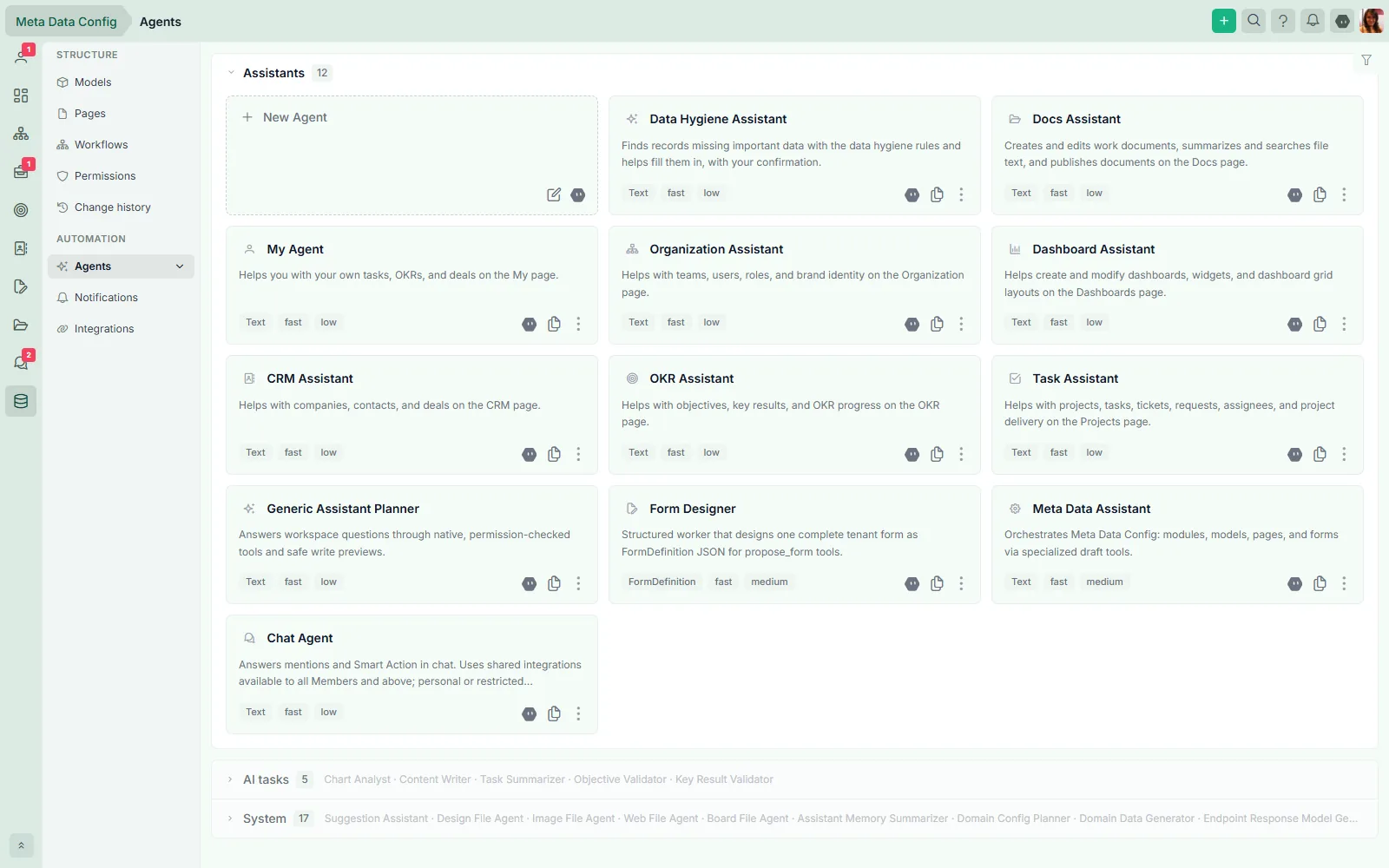
AI Agents: automate tasks with prompts, not code
Every workspace accumulates work that follows a pattern: read this record, summarise it, draft a reply, classify the input, generate a document. Doing it manually every time is waste.
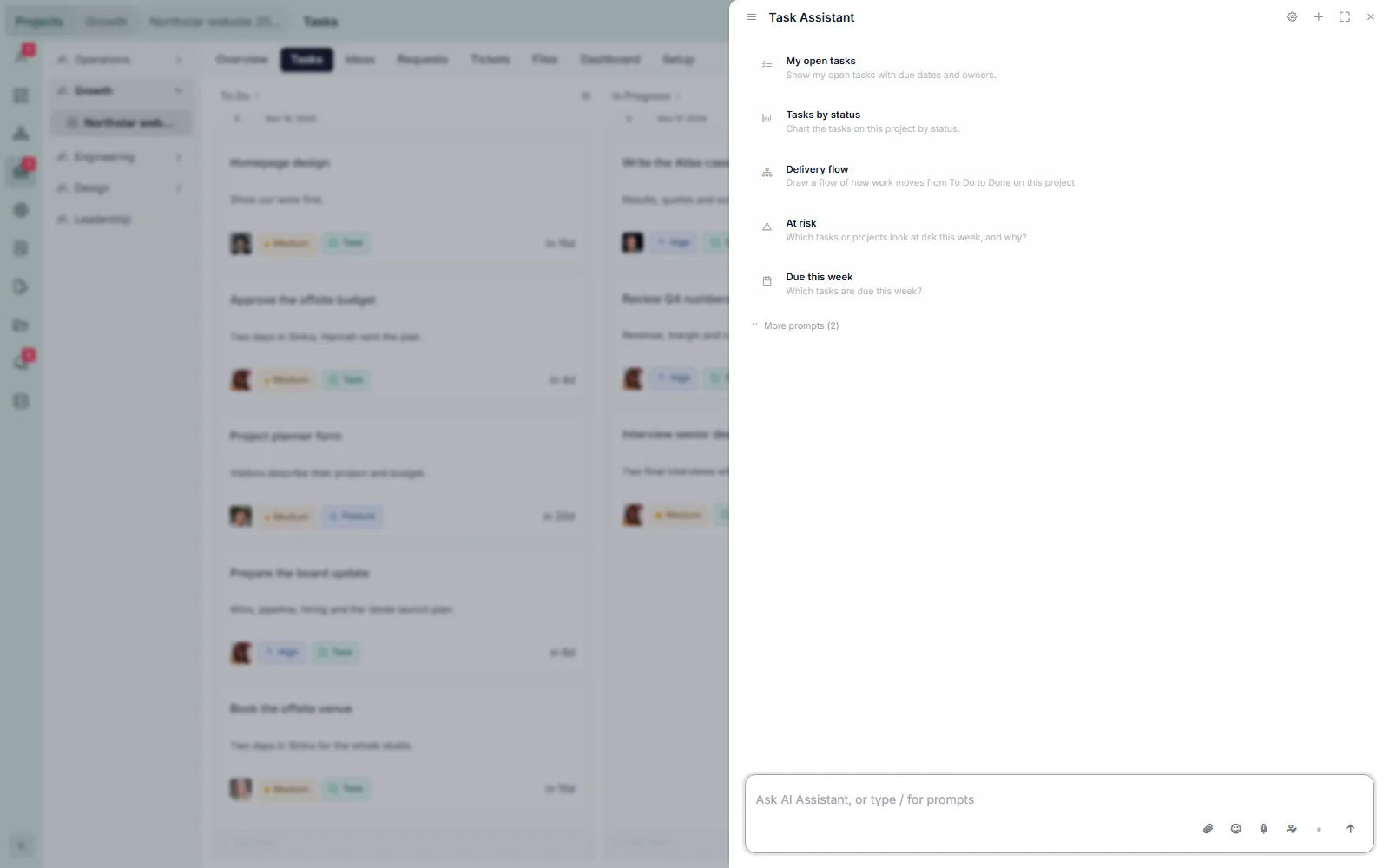
AI Assistant: ask about the page you are on
Sparkles or Ctrl/Cmd+J opens a chat that already knows the screen in front of you. Ask about your tasks, deals, or key results without leaving the page.
AI dashboards: asking your data questions in plain language
A dashboard is a screen that shows your business numbers as charts. With an AI dashboard you ask for a chart in a normal sentence instead of setting it up by hand. The numbers still come from your own records.
AI-first vs AI-native vs AI-enabled
AI-first vs AI-native vs AI-enabled in plain words. AI-enabled means AI was added to an existing product. AI-first means a team thinks of AI before anything else. AI-native means the product was built around AI from the start.
AI-generated code vs configured software: where the risk sits
AI can build a business tool in two ways. It can write a whole new program, and then its safety is yours to check. Or it can set up a tool inside an existing platform that someone else keeps safe. This guide shows who is responsible for what.
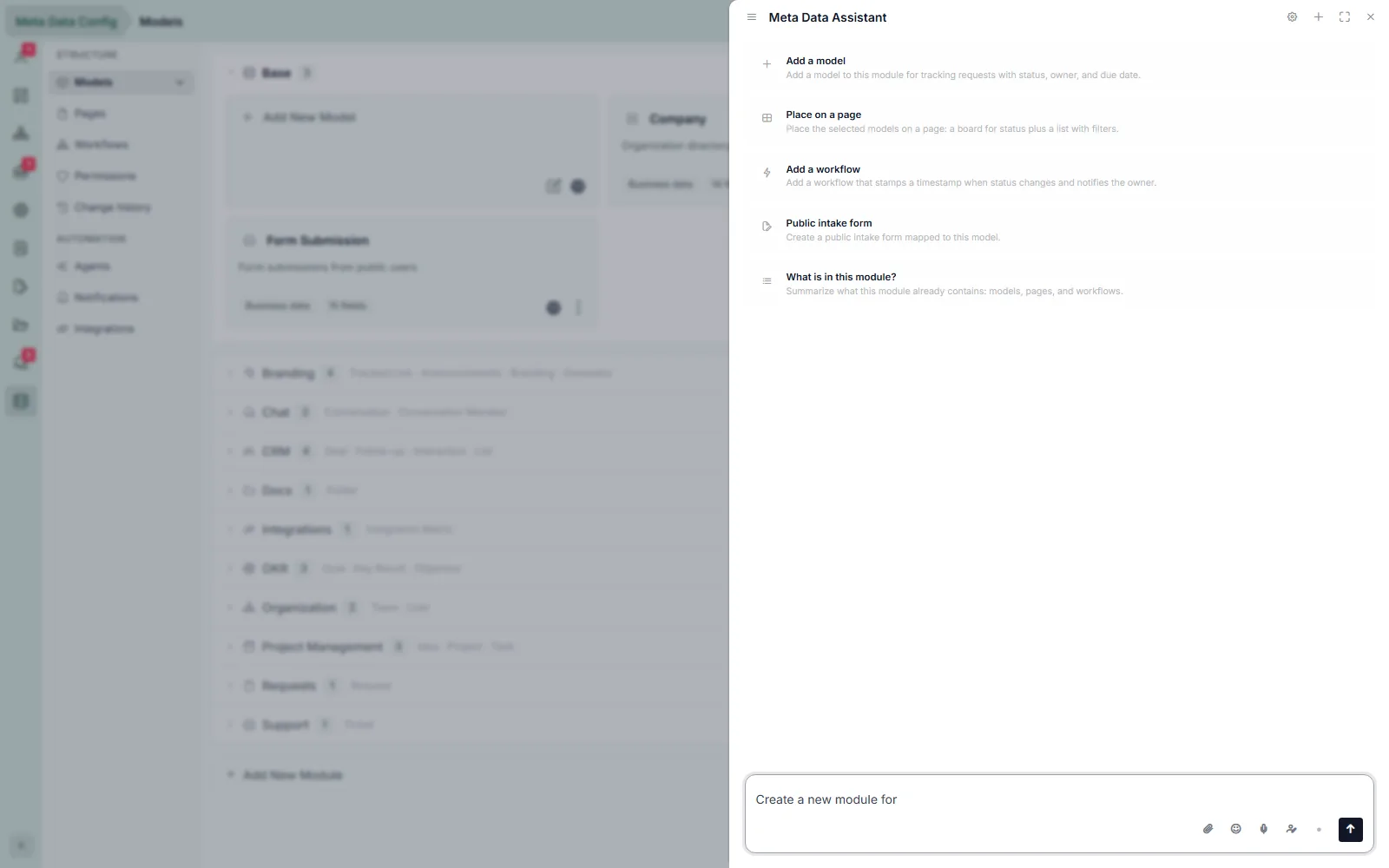
Module Builder: Create exactly the modules your business needs
Every module you create in Worknano is deeply connected to everything else, workflows, permissions, files, reporting, AI Agents, and process mining.
An AI readiness checklist for a small company
An AI readiness checklist shows a small company whether it is ready to let AI help with daily work. Twelve yes-or-no questions on your data, your process, your rules and your people tell you what to fix first.
All-in-one vs best-of-breed software: a decision guide
All-in-one software runs several parts of your business in one program. Best-of-breed means a separate specialist program for each job, connected to the others. This guide shows how to decide, job by job.
Worknano API: Clean, Consistent, and Extremely Flexible
Worknano is more than an all-in-one workspace. It is a complete operating system for ambitious startups and growing teams.
Approval workflows: five patterns that do not slow people down
An approval workflow sends a request, such as an expense or a holiday, to the people who must say yes. Five simple patterns keep it quick, so that requests do not sit for days in someone's inbox.
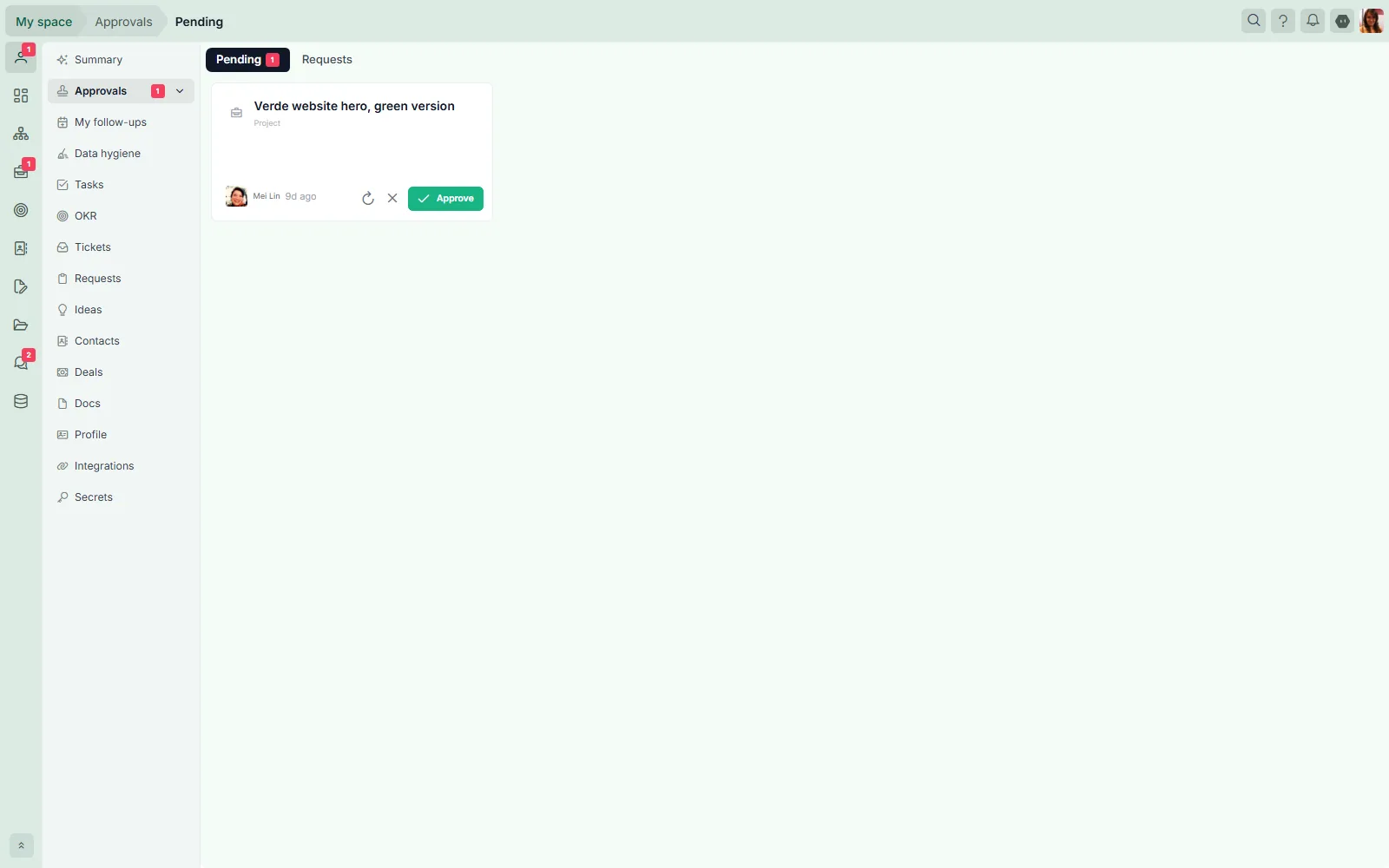
Stop chasing people for signatures. Build automated approval workflows that just work.
The Approvals module turns the frustrating "let me get back to you" delay into a smooth, tracked workflow. Instead of sending Slack messages or endless follow-up emails, your team can submit requests and get formal sign-offs automatically.
Are AI agents deterministic?
AI agents are not deterministic. Ask the same thing twice and the answer can come out a little differently. That is fine for wording and risky for prices, so let fixed rules handle the parts that must never change.
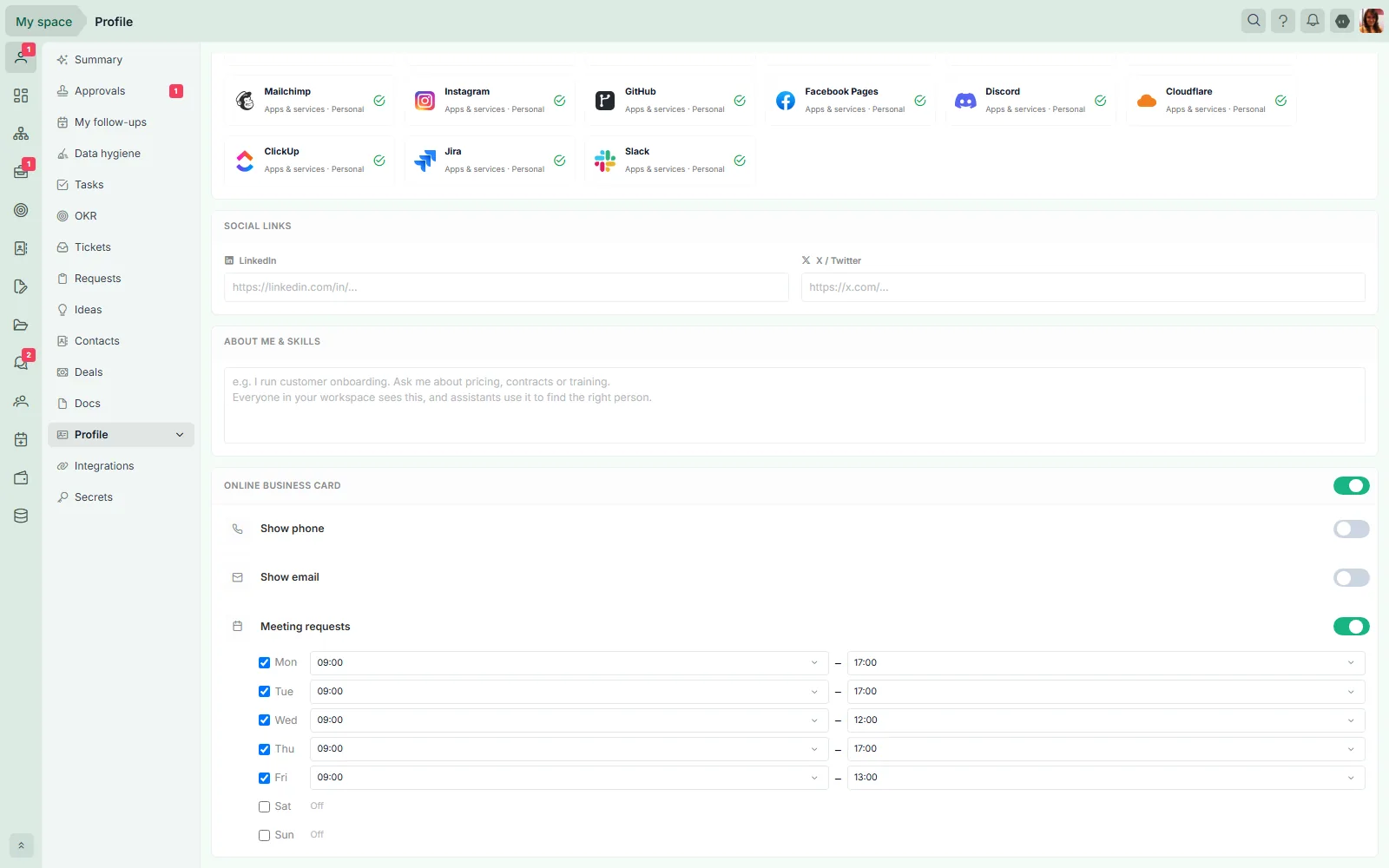
Meeting booking built into your team profiles, not tacked on
Most scheduling tools require you to manage messy external links that sit outside of your main business profile. Worknano Booking integrates your calendar right into your public-facing team presence.
Boutique Hotel Chain: From Manual Chaos to Instant Bookings
"We scoped a 6-month, €45k custom build, but it was just too much.
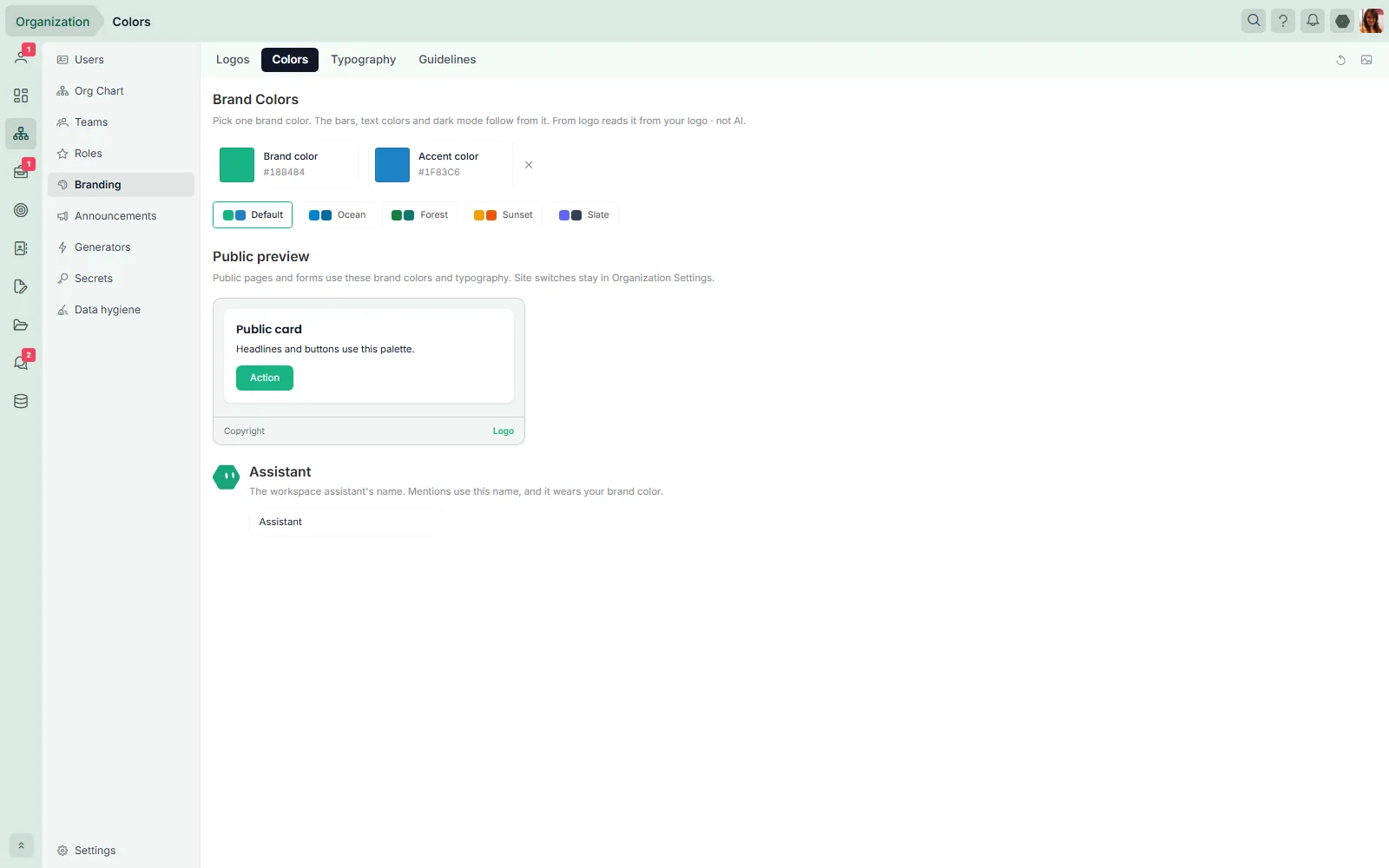
Your brand, in one place not scattered across ten tools.
One team uses one shade of green on the website, another uses a slightly different one in proposals, and the invoice has a third. Worknano Branding brings it all together: colors, logos, fonts and guidelines live in one module and flow into every email, document, page and campaign.
Budget vs actuals: a simple monthly routine for small teams
Budget vs actuals means comparing what you planned to spend with what you really spent. Done once a month, it takes less than an hour. This guide shows a simple routine and an example with real numbers.
Build, buy or compose: internal tools in the AI era
Build vs buy software used to be a choice of two. Today there is a third way. To compose means to put your own tool together from ready parts, on a platform that someone else keeps running.
Build your own agent: from a default to a custom helper in minutes
An agent in Worknano is a name, instructions, tools and a model. Duplicate a default, start blank or ask the Meta Data Assistant, then attach it to a page, a workflow or a chat.
Building your 21st module with AI: a working playbook
Every business has at least one module that no off-the-shelf SaaS quite covers. A bespoke compliance tracker for a regulated industry. A donor-care system for a non-profit. Worknano's data-model designer plus AI assistance closes the gap from weeks to an afternoon.
Can AI agents go rogue?
Can AI agents go rogue? Not as in the films. But an agent can misunderstand a task and do the wrong thing. How much harm that causes depends on what it is allowed to reach, and you decide that.
Can AI agents run locally? Local models for a small business
Yes, AI agents can run locally. The AI behind an agent can run on a computer you own instead of at an AI company on the internet. This guide explains in plain words what that takes and how to decide.
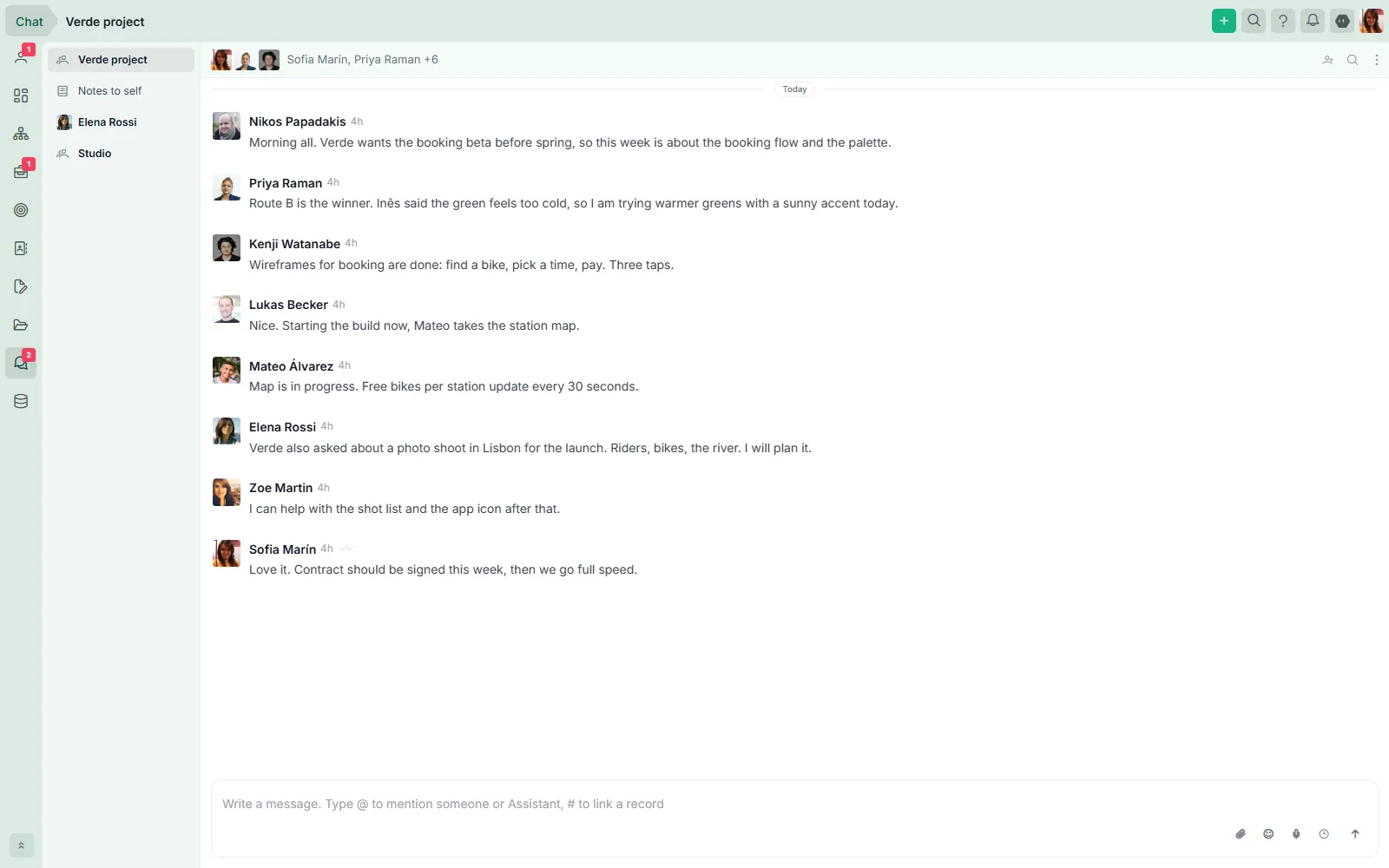
Chat: a topic on the work, not another inbox
Topics stay on the record. People and the Worknano Assistant reply in the same thread, without a separate Slack workspace.
Choosing workflow software for your small business
The right workflow software for a small business is one your own team can change without a specialist, and one that works with the information you already have. Workflow software passes work from one step and one person to the next, so nobody has to chase it.
How to connect Claude or ChatGPT to your company data
You can connect Claude or ChatGPT to company data in three ways. Upload files, switch on a ready-made link to your documents, or link the AI to your business software. This guide compares them and gives a five-step plan.
Contact Sales: skip the form, talk to a human
Most sales pages send you to a form, then to an SDR, then to an AE, then to a follow-up, then to a quote. We are a small team and we cut that chain.
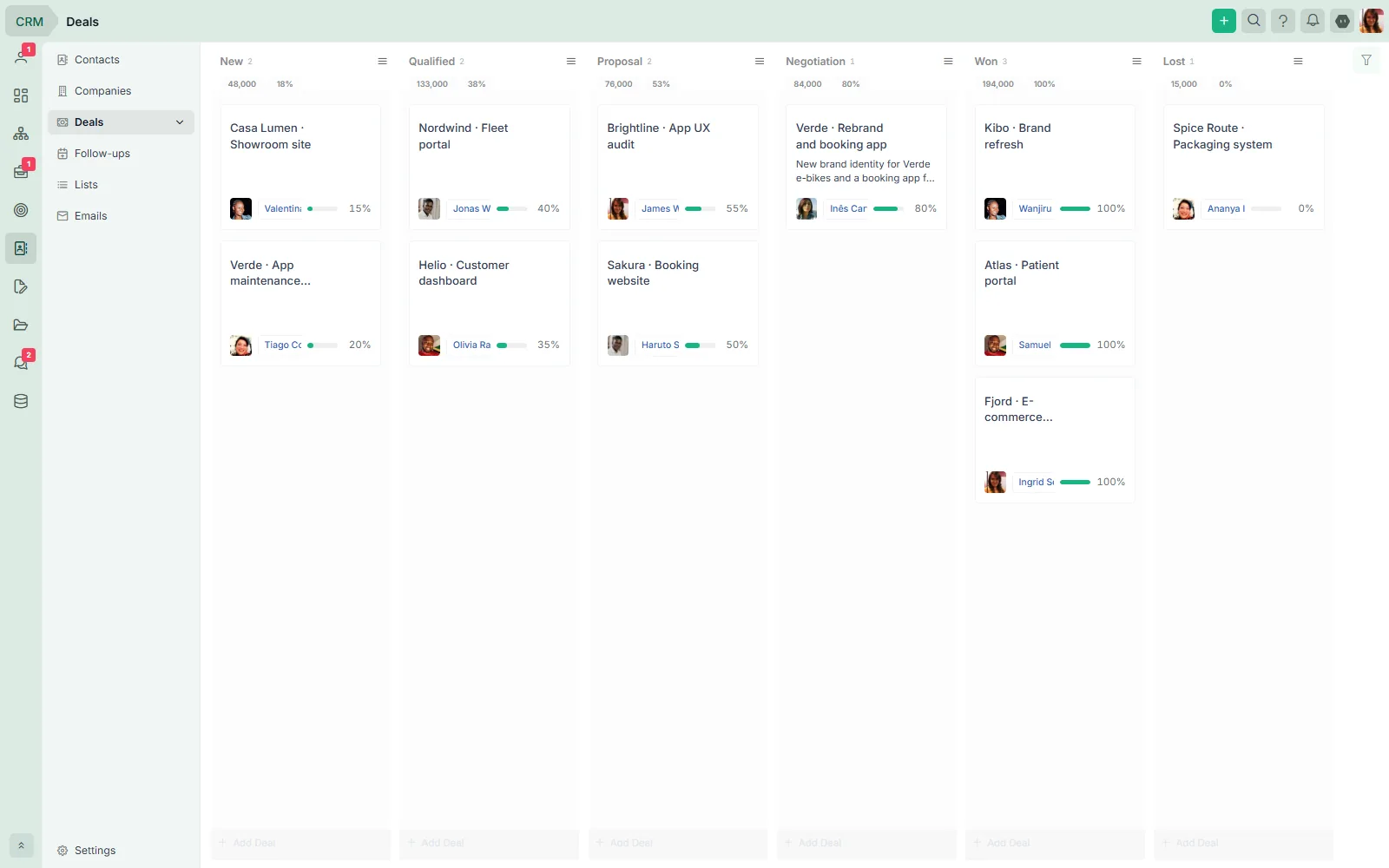
CRM that lives inside your workspace, not on the side of it
Most CRMs treat your sales pipeline like an isolated island. The deal lives there, but proposals are in another tool, invoices in finance, onboarding tasks somewhere else, and customer data gets copied across five different places.
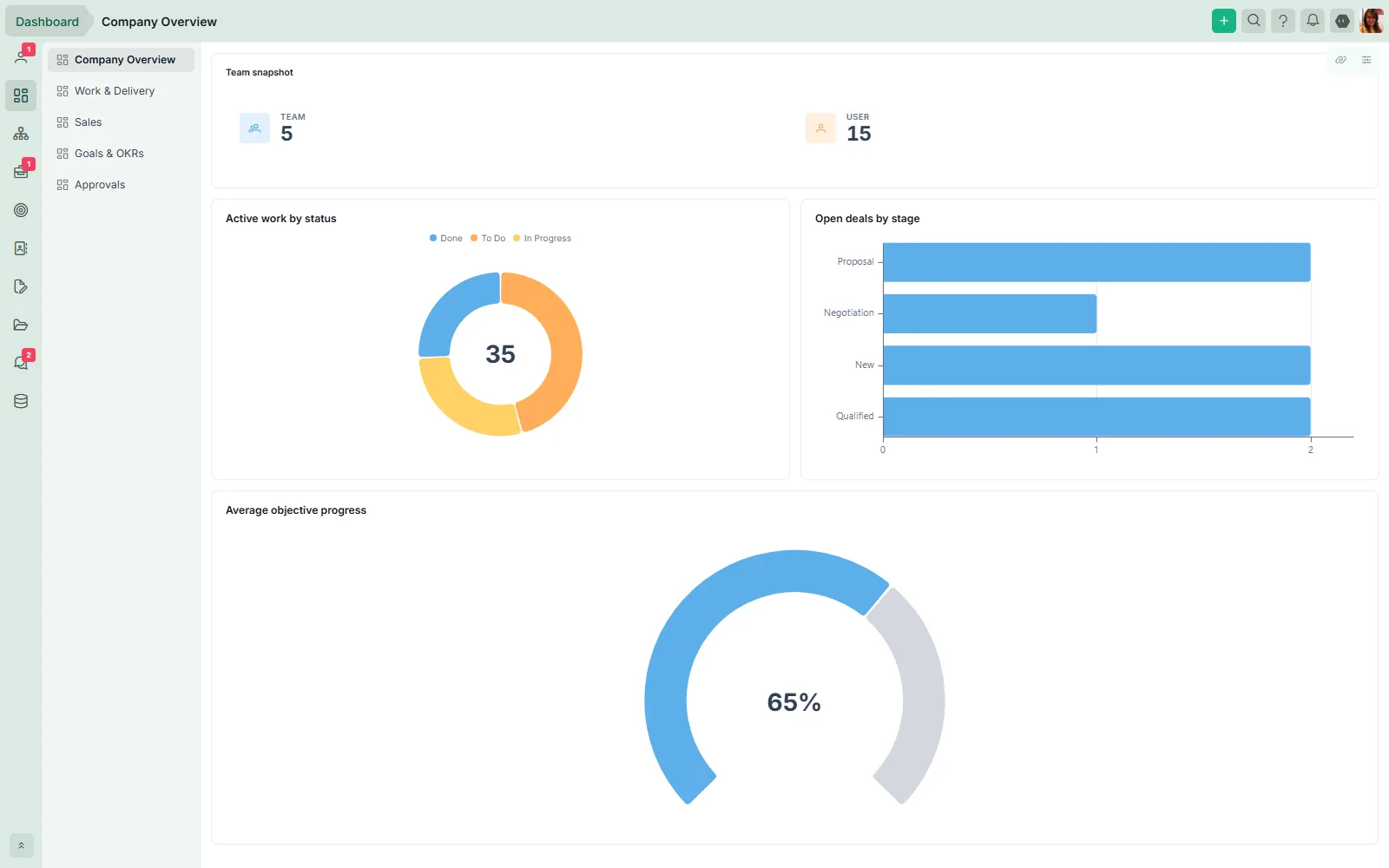
Dashboards that are wired to the actual work
Most dashboards live in a separate tool, refresh on a schedule, and tell you what already happened. Worknano Dashboards are inside the workspace, built from the same data your team works in, so the number you see and the record behind it are one click apart.
Why a business needs a data automation strategy
A data automation strategy is a one-page plan for how information comes into your company and gets where it is needed without anyone typing it twice. Here is why a business needs one and what goes on the page.
Data hygiene: why AI agents fail on messy data
Data hygiene means keeping your business records complete, up to date and free of double entries. AI agents fail on messy data because they take every entry as true. They cannot ask a colleague what was really meant.
Data hygiene: rules that keep important fields filled
Define rules for missing owners, dates and stale updates. Worknano scores your data, shows each person their gaps, sends a daily digest and lets an agent help fix them.
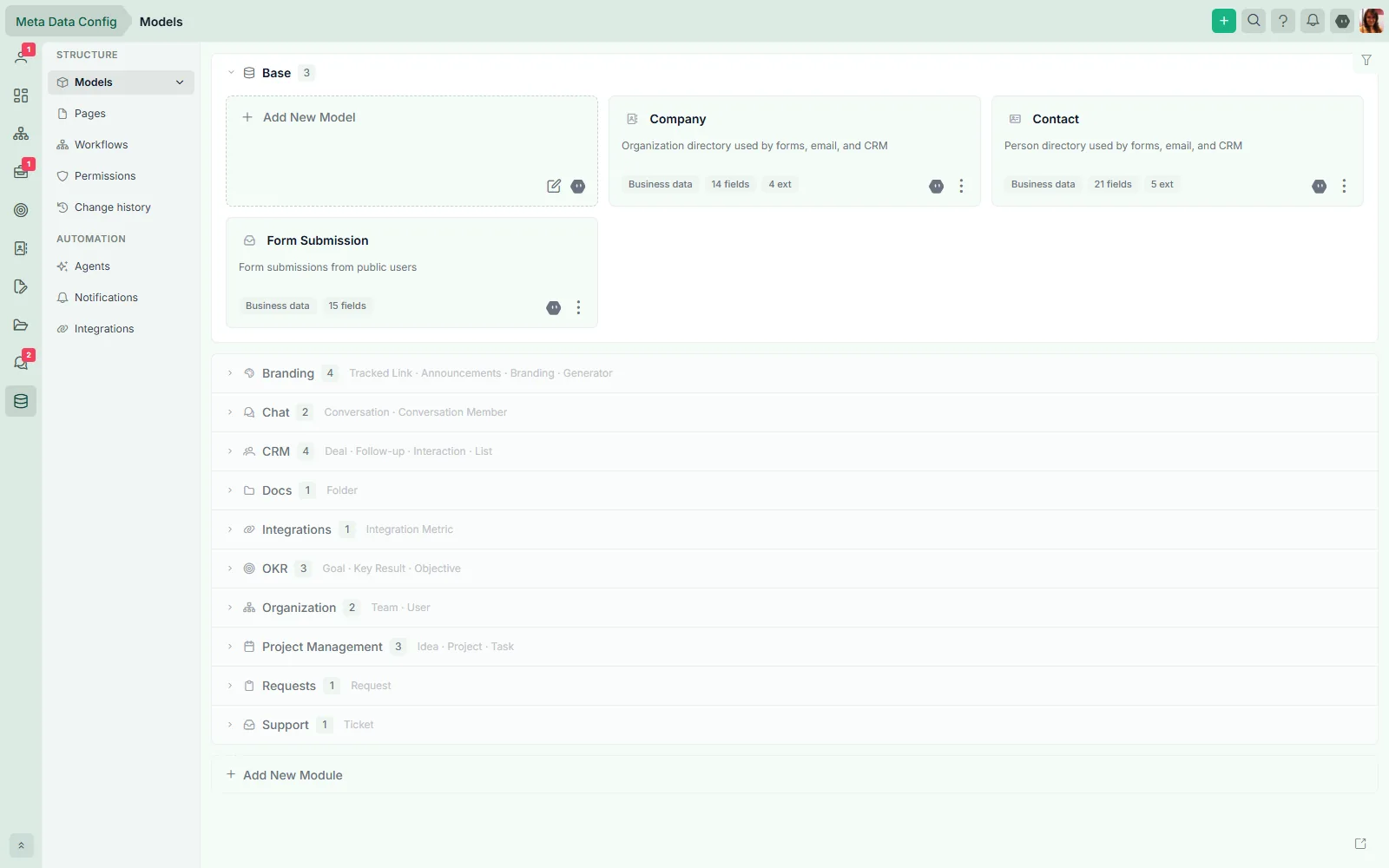
Your data model, visible and editable, no migrations required
Your data should fit your business. Not the other way around. Most SaaS tools give you the columns their engineers decided you need.
How to edit a page assistant and a reusable agent
This lives under Config → Agents. Sparkles opens the page assistant. A reusable agent is prompt, tools, output. You run it from a record, in bulk, or as a workflow step. There is no foreign key to agent. Turn the editor off and shipped agents still run.
How to use the page assistant (sparkles / Ctrl+J)
Sparkles or Ctrl/Cmd+J opens the assistant for the page you are on. Starter cards, the composer, History, and +. Walk me can skip to this drawer. It is not the Agents editor.
How to post an announcement
This lives under Organization. Founders and Directors usually see it. Header + writes a dialog, a Summary notice, or an email / notification. Set audience, theme, and dates. Dialogs can show once or on every login.
How to approve or reject a request
This lives under My. You do not create an approval by hand. Open Approvals, stay on Pending, decide, leave a comment if the form asks. Requests is what you submitted. A secret ask is a common example.
Brand kit: logos, colors, and fonts in the workspace
This lives under Organization. Logos, colors, typography, guidelines, and the email frame. Double-click a swatch, Reset, or From logo. Colors, fonts, and logos stay headings here. They do not get their own URLs.
How to use Chat: messages, replies, reactions, and your switches
Green + starts a direct chat or a small group. @ mentions, # links a record, attach a file. Hover to react, reply, or forward. Settings: left or right, side panel or inline, voice language, and the two chat notices.
Workspace admin: models, pages, and workflows
Config sits at the bottom of the sidebar for people who set up the workspace. Pages and Notifications stay on this screen. Other editors have their own docs. A missing tab means that editor is off. Shipped automations still run.
How to use the sales CRM: company, contact, and deal
Open a company, add a contact, create a deal, drag it to the next stage. Save a list you always look at. Send an email template. That writes the send log. You do not type history by hand.
How to create a KPI dashboard and add a widget
Create a dashboard, set who can open it, add a widget, pick what to count and how to group. Preview on the right. Move and resize, then save. Click a chart slice when it is set up to open that list.
How to call the Worknano API
This lives under Docs, not as a Config tab. One HTTP shape for every module. GET /api/v1/object/{model}/{id} reads one. GET /api/v1/objects/{model} lists. POST, PATCH, and DELETE write. Workflows call this. Store keys in Secrets.
How to share a file and set folder access
Open a folder, add a file or upload, set who can see the folder. Double-click in list to preview. Double-click in icons to edit. Publish one file for a public link. Templates stay internal.
How to create a form: style, logic, assessment, and submissions
New Form or header +. Describe it to the assistant or build it yourself. Set style, labels, logic, scoring, who can see it, captcha, languages, CRM connect. Visitors submit. You read the inbox.
Email signature generator and link templates
This lives under Organization. Templates for QR codes, tracked links, signatures, and files from the person and the brand kit. Header + adds one. The replay icon restores the built-in generators.
How to add an integration endpoint and read the API log
This lives under Config → Integrations. Set path and method on the endpoint. Mapping lives on the workflow step. Inbound webhooks push in. The API log is read-only when a step fails. Keys go in Secrets.
How to connect Claude, Cursor and other AI apps with MCP
Every workspace has an MCP server. An admin turns it on in Organization → Settings. You click Connect in My → Integrations, copy the Server URL and your personal key, and add both to Claude, Claude Code, Cursor, Codex or Gemini CLI. The app then works with your permissions.
How to edit a model and its fields
This lives under Config → Models. Click a module card, open a record type, prefer an existing field. Connectable plus Connect on the record binds a live count. Connected Fields only lists those binds.
How to add a page with the assistant or by hand
This lives under Config → Pages. Add New Page, sparkles on that card, or header + opens the assistant so you describe the screen. The pen sets name, label, icon, layout, and sections by hand. A yellow DRAFT badge stays until you save all changes.
How to use My: your work, approvals, and profile
Open My from the left sidebar. Jump from Summary into a record, ask My Agent, approve something, add a task on your board, and request a company secret.
How to read the bell and edit notification templates
Click the header bell. A row opens its path and marks read. You cannot invent rows. Admins edit templates under Config → Notifications: {field}, {fk.field}, to_paths, email or chat. A workflow NOTIFY writes them.
How to update an OKR: period, objective, and key result
Change year and quarter, add an objective, nest a key result, type the current value. Progress is a number. You do not drag this on a board. Filter by owner. Your RACI rows also sit under My.
Org chart: who reports to whom
This lives under Organization. Click Org chart in the left sidebar. Click a person or a team to open details. It is a picture of Users and Teams, not a slide you export once and forget.
Organization: directory, org chart, and brand studio
Organization is the company directory and brand studio. The left sidebar switches sections. There is no top tab bar. Invite people, set teams, then open Secrets, the org chart, generators, announcements, or the brand kit.
How to set who can read, create, or approve a record
This lives under Config → Permissions. Open a record type and set which roles can read, create, update, delete, or approve. Access levels sit on the person and can unlock a module. You assign the role on the user in Organization.
How to set your profile, public card, and meeting hours
This lives under My → Profile. Hover the avatar, open View Card, toggle phone and email, set calendar hours, then Add to phone. That is your identity, not Organization → Users.
How to run a kanban board: tasks, ideas, and tickets
Pick a project, add a task at the bottom of a column, drag it when status changes, open the card to set a date. Use List for Backlog, Timeline for dates, Ideas then a task, project chat.
How to add a shared secret and request access
Open Organization → Secrets. Header + adds a company login. Mark it Requestable so someone can ask from My → Secrets. You approve on My → Approvals. Personal logins stay on My → Secrets.
How to run the ticket inbox on a project
This lives under Projects → Tickets. If Support is off, the tab hides. Quick-add a title, set type, priority, channel, and requester. Escalate to a task or an idea. Resolve when done. Do not reuse a task for intake.
How to add a workflow: manual, scheduled, or auto
This lives under Config → Workflows. Daily work is the ⋮ menu on a record. Admins add Manual, Scheduled, or Auto here. Connected Fields is a fourth tab, not a class. A step can set, notify, call, approve, or run an agent.
Worknano docs: how to use the workspace
How-to pages for My, Projects, CRM, OKRs, Organization, Config, and the API. Each page says what to click and what happens next.
Does AI train on our data? Questions to ask any vendor
Does AI train on our data? That depends on the product and the contract, not on AI as such. Reading your text to answer a question is not the same as learning from it. Here are five questions to ask any supplier.
DTC Fashion Brand: Reducing Fulfillment Errors by 70%
"Our mix of Shopify, Airtable, and WhatsApp was constant chaos, leading to a 12% error rate.
E-commerce Ops: Syncing Marketing and Logistics
"Our Shopify store, email marketing, and logistics tools never talked to each other. Nobody had a unified view of the customer.", Sofia Rossi, Head of Ops, Verde & Co (Milan, €4.2M revenue) The Problem: Slow handoffs between the marketing and logistics teams were creating a poor experience for their customers.
An employee onboarding checklist that survives week two
An employee onboarding checklist lists everything a new colleague needs to settle in, with a name and a date next to each step. Most lists stop after day one. This one runs from the signed contract to day 90.
Enterprise: a dedicated instance with sub-tenants
Run Worknano on a dedicated instance and give each company in your organization its own isolated sub-tenant, with its own users, data, brand and domain.
The EU AI Act for small businesses: a short orientation
The EU AI Act is the European law on artificial intelligence. It sorts uses of AI by risk, and most of what a small business does with AI falls into the lower levels. Here are the levels and four first steps, in plain words.
Event registration: a planning checklist
An event registration checklist makes sure everyone who wants to come can sign up, knows what happens next and is on the list at the door. This one has five steps, from the first decisions to the thank-you message.
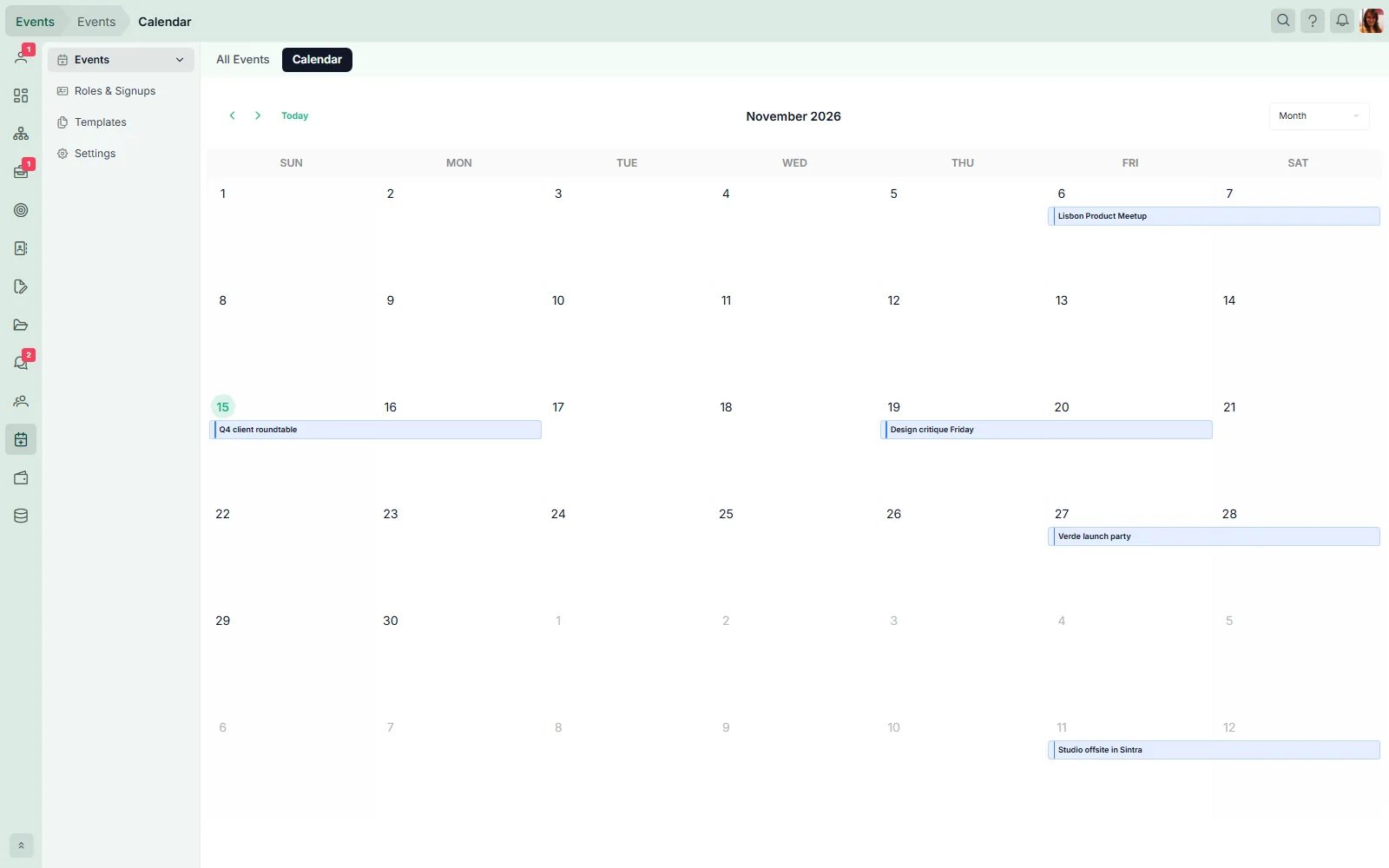
Events and stuff scheduler from registration to follow-up, in one workspace
Running an event today usually means a registration tool, an email tool, a check-in app, a survey tool, a payment processor and a spreadsheet to glue them together. Worknano Events ships every step in one workspace, so the attendee record is the same record from registration to follow-up email three weeks later.
What if I need a module Worknano doesn't ship?
Describe it in plain English. The AI Module Builder generates the data model, input form, workflow, and report inside the same auth and database.
Which AI model does the AI Module Builder use?
Flexible LLM configuration. You can connect any model you choose, including local deployments, open-source models, or your company's own private endpoint. You're never locked into a single provider.
What happens to our data if we cancel?
Your data belongs entirely to you. Every list view exports to Excel, CSV, or PDF.
Where is our data stored, and is it secure?
You choose regional hosting in the EU, the USA or APAC, and your workspace data and AI processing stay in that region. All data is encrypted at rest (AES-256) and in transit (TLS 1.3).
Is Worknano GDPR compliant?
Yes. Data is stored in the EU (Frankfurt) by default, each tenant's database is fully isolated, and we sign a Data Processing Agreement on request.
Can I migrate existing data?
Yes. CSV and Excel imports are supported out of the box and map directly into CRM, Projects, and HR with auto-suggested field mapping.
How granular are permissions?
Permissions are scoped at every level: role, module, model, field, and record. You can invite a freelancer or advisor to see one specific project board without exposing your financial metrics or internal discussions.
How does pricing work while you're in early access?
Worknano is priced per company, never per user, so adding teammates never changes your bill. Right now we're in early access, which means it's free for early-stage startups, and founding members who join now lock in perks as we grow.
Can we self-host or get a dedicated instance?
Yes. A dedicated single-tenant instance or an on-premise deployment on your own infrastructure is available on our Enterprise plan.
Can an enterprise run several companies in Worknano?
Yes. On the Enterprise plan, Worknano runs on a dedicated instance for your organization, and each of your companies gets its own sub-tenant with its own users, data, brand and domain, fully isolated from the others.
Why not just build it ourselves with AI?
It’s safe, there’s nothing to maintain, it’s all in one, and our team runs the engine for you.
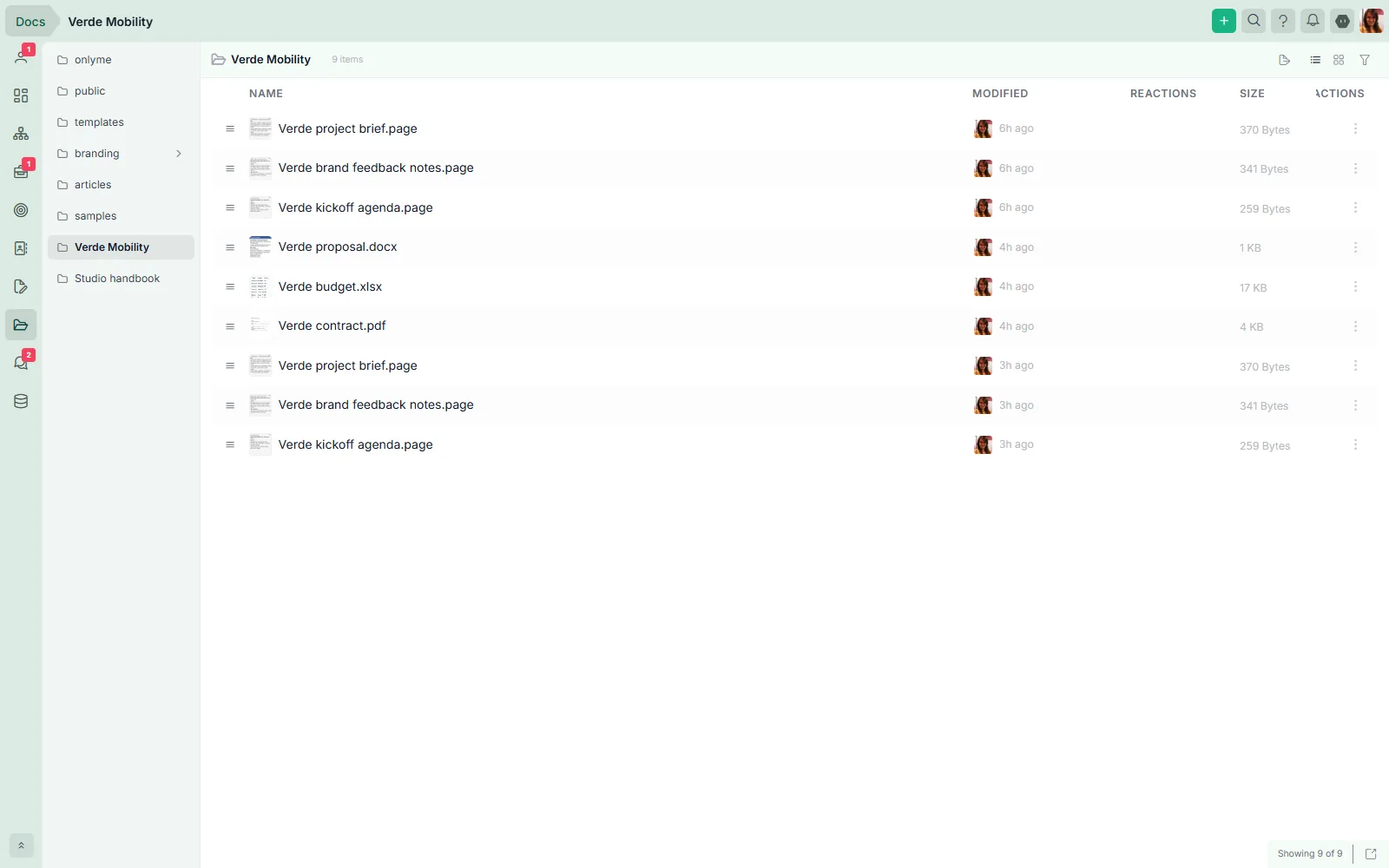
Files: edit documents, spreadsheets, images and media in your workspace
Edit Word, Excel, PowerPoint, PDF, images, drawings and media projects in one workspace. Coordinate edits with phase-one co-editing, and ask AI agents to create files or propose changes.
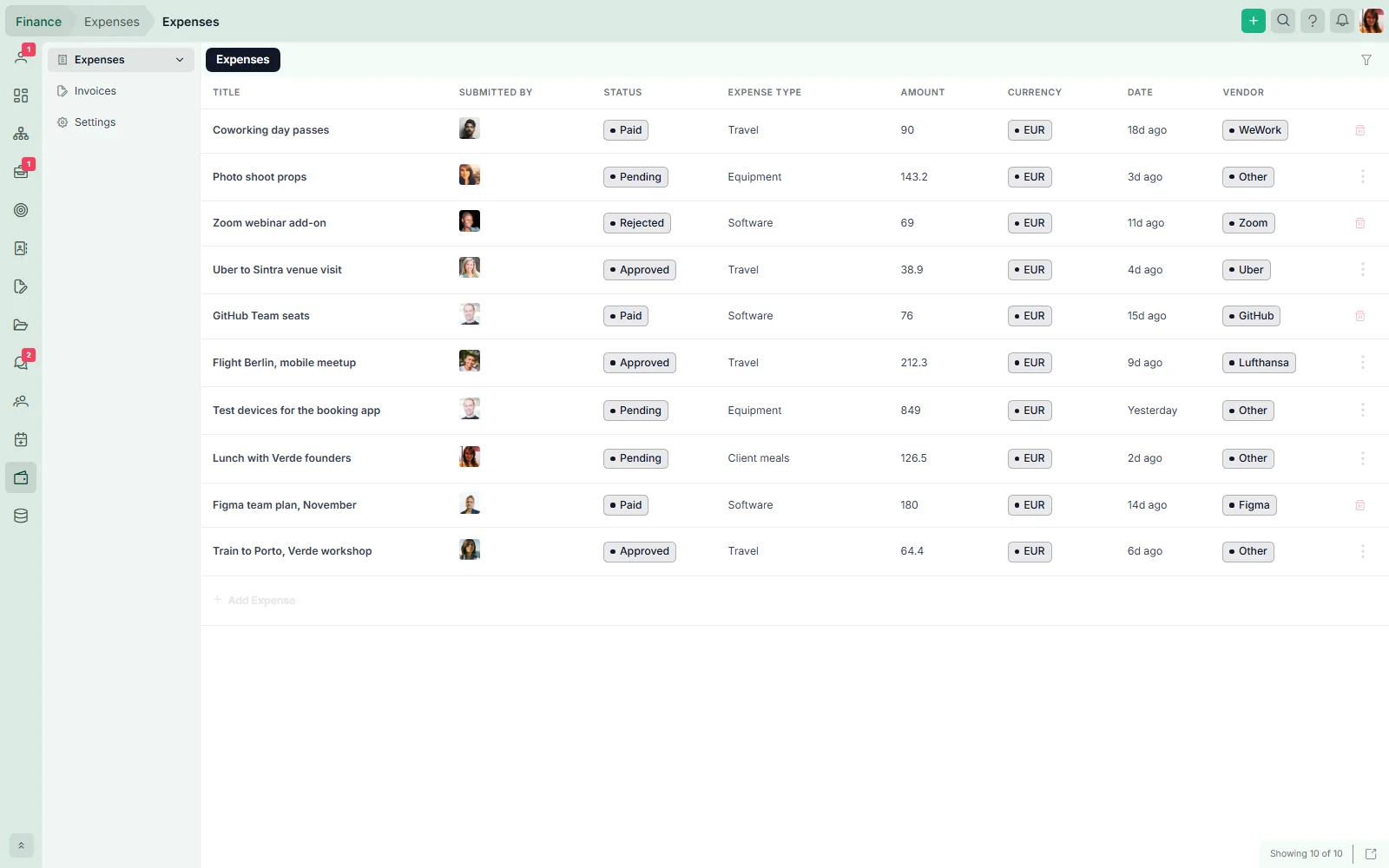
Your finance stack shouldn't require a finance team.
Worknano Expenses is where receipts get logged, invoices go out, and nothing falls through the cracks, without needing a bookkeeper to hold it together. Receipts that read themselves No more chasing the team for receipts at month-end.
Folder structure and file naming for a small company
A good folder structure lets anyone in the company find a file without asking who saved it. You need a few main folders, the same layout inside every client folder, and one way of naming files. Here is a scheme you can copy.
Run the whole startup before you can afford a COO.
You're 4 people. You ship something every week. Your stack already costs €600/month and nothing talks to anything. We've been there.
Why people abandon forms, and how to design ones they finish
Form design best practices come down to three things. Ask less, say clearly what you want, and never lose what someone has typed. This guide shows why people give up on forms and rebuilds a contact form as an example.
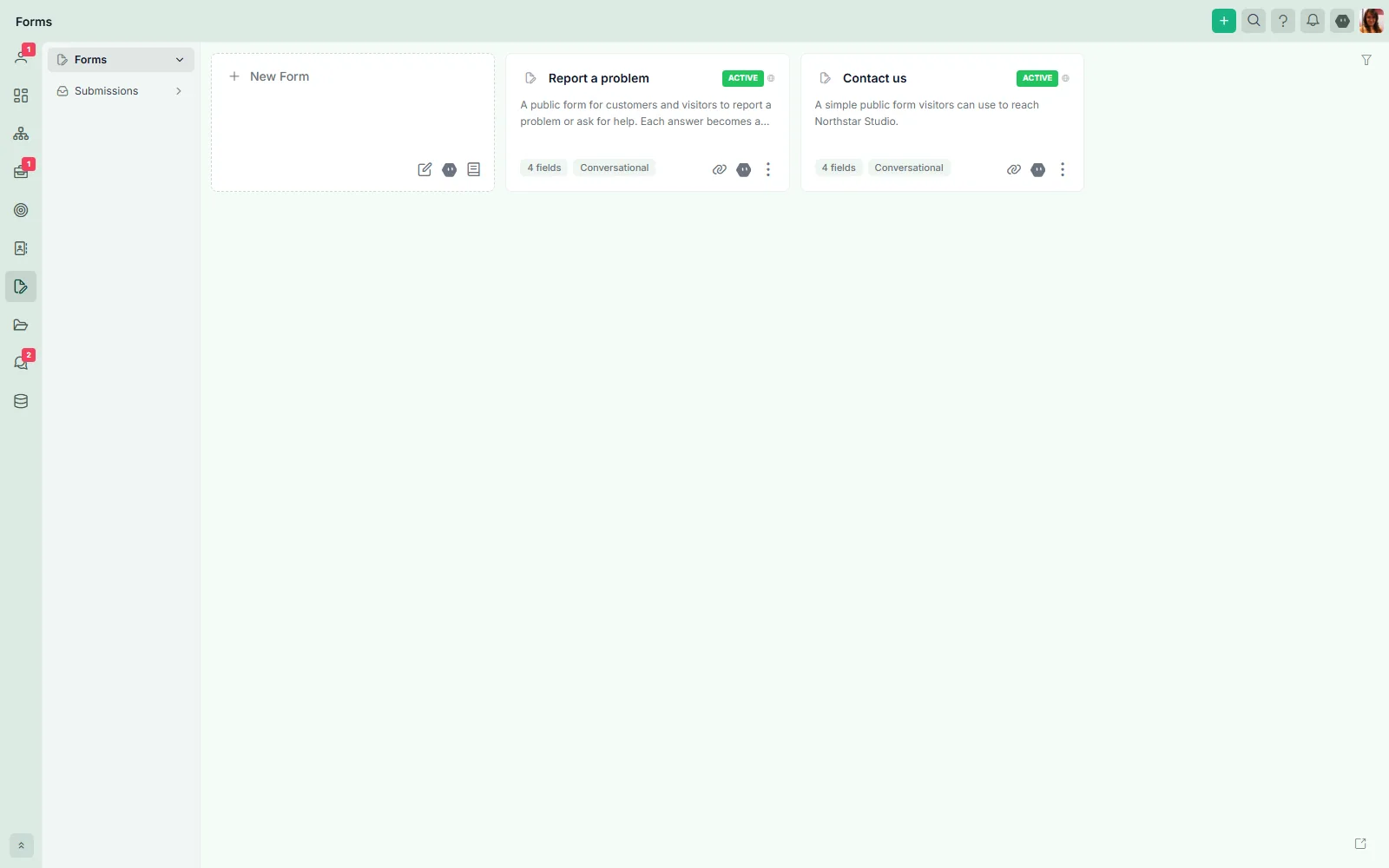
Forms that are also a CRM, also a database, also a workflow
Most form tools are just simple inboxes with a pretty interface on top. You build a form, embed it on your website, and then the responses just pile up in a cold list that you have to constantly monitor.
How a French scale-up cut SaaS spend by 60%
"We were juggling 12 different tools, none of which talked to each other.
GDPR and AI agents: what a small business has to think about
GDPR, the EU's data protection law, applies to AI agents as soon as they read or change information about people. A small business should know four things about each agent, namely what data it uses, why, where and who is responsible.
How is Worknano different from popular SaaS tools and vibe-coded apps?
Popular SaaS tools work in isolation. Each has its own database, its own auth, and no awareness of your other tools, so data silos pile up fast.
How to become an AI-native company, step by step
An AI-native company lets AI prepare the routine work while people check and decide. An existing business gets there one task at a time. Here is a plan in six small steps that fits beside normal daily work.
How to build an AI agent for your business, step by step
To build an AI agent you pick one small job, describe it in plain words and test it on real cases. This guide walks through six steps that need no programming, with a filled-in example.
How to identify bottlenecks in a process
To identify bottlenecks in a process, look at where work waits, not at who works slowly. A bottleneck is the one step where work piles up, like the narrow neck of a bottle that decides how fast the water comes out.
How to plan your work day: one list instead of five inboxes
To plan your work day, write everything that is waiting for you on one list, choose the three things that must get done today, give each a time in the calendar, and leave room for what turns up during the day. The routine takes about fifteen minutes.
Online booking: how to reduce no-shows
To reduce no-shows, confirm every appointment at once, send a reminder the day before and make it easy to change the time. This guide follows an appointment from booking to the day itself and shows what to do when.
How to test an AI agent before you trust it
To test an AI agent, give it real cases from your business where you already know the right result, and compare. An AI agent is a program that uses AI to carry out tasks for you, such as sorting enquiries or drafting replies.
HR software for a 10-person company: what you need and what you can skip
HR software for a small business of ten people needs to do four things. It keeps staff details, tracks holidays and sick days, stores documents safely and guides new starters. The rest can wait.
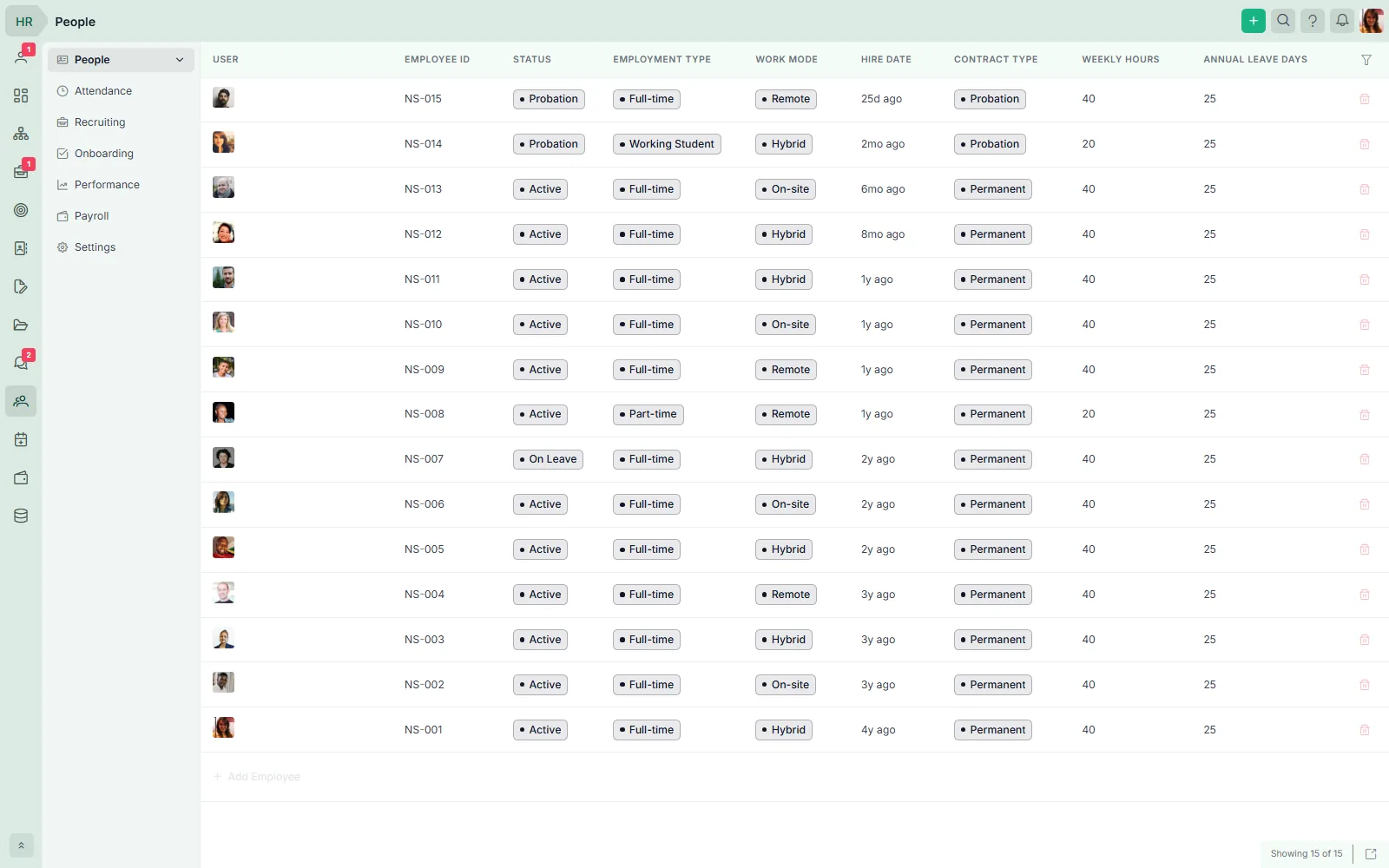
HR for teams that want to ship, not paperwork
HR for teams that want to ship, not paperwork Most HR tools force you into rigid templates and limited fields. Worknano gives you a complete, flexible HR system that adapts to how your company actually works, right from day one.
Human in the loop vs human on the loop: when should AI ask first?
Human in the loop means the AI asks a person before it acts. Human on the loop means the AI acts and a person checks afterwards and can step in. Two simple questions tell you which tasks need which.
The integration tax: what connecting ten tools really costs
The cost of SaaS integrations is mostly not on any invoice. It is the hours your team spends setting up, watching and repairing the connections between its software tools. This guide shows the five parts and how to add them up.
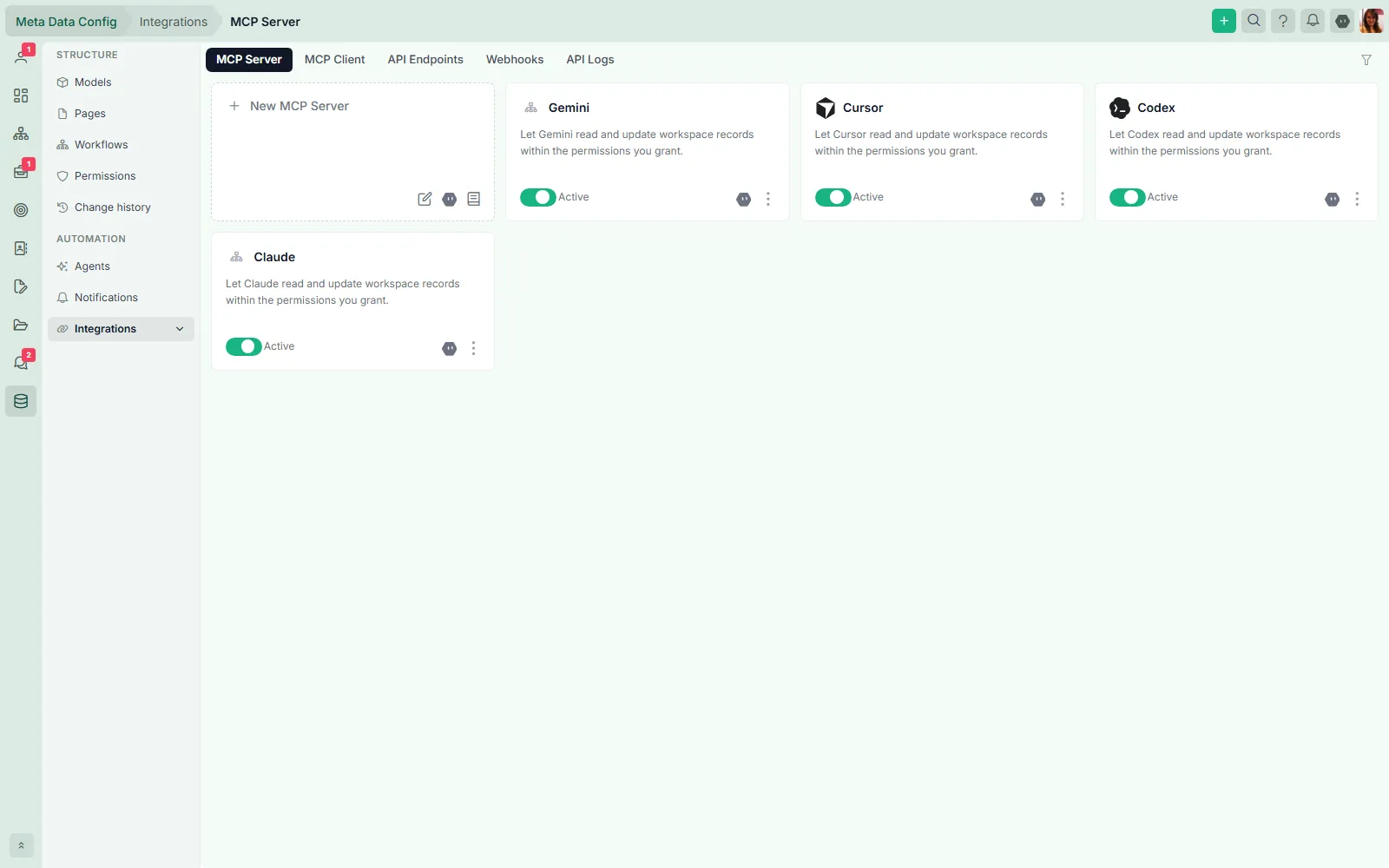
Integrations: connect your stack in clicks, not tickets
Integration is where SaaS dreams go to die. The vendor's marketplace lists your tool, you click connect, you wait three minutes, and either nothing happens or it only works for the one trivial case the demo covered.
Worknano for investors: Your company, one platform
One connected platform for your company, with the missing tools built safely by asking.
Is MCP safe? Risks and how to limit them
Is MCP safe? MCP connects an AI app such as Claude or ChatGPT to your business software. It is as safe as the access you give it. Here are the main risks and a careful way to start.
Is vibe coding safe for business apps?
Vibe coding means letting an AI write a program from your description. It is safe for trial versions and small tools that hold nothing sensitive. For business apps with customer data or money, it is only safe when an expert checks and looks after the result.
Kanban vs Gantt vs list: picking a project view
A kanban board shows how far each task is. A Gantt chart shows when each task happens. A list shows everything at once. This guide explains the three project views in plain words and when to use which.
Keyword search vs semantic search
Keyword search finds text that contains the exact words you typed. Semantic search finds text that means the same as your question, even when the words are different. Each is better for different searches, and good search combines both.
Launch in a weekend: a working business in 48 hours
Most new businesses waste their first month evaluating tools and their second month trying to make them all talk to each other. By month three they finally have a stack but still no customers.
Look legit on day one: a brand-aware workspace before your first sale
Looking professional in your first year used to be exhausting. You needed a designer, a brand book, a website agency, separate invoicing templates, email signature tools, and the discipline to keep everything perfectly in sync.
Manufacturing SME: Gaining Production Visibility
"Excel hell and an expensive, rigid ERP left us blind to bottlenecks.
Marketing Agency: Client Portals That Finally Impress
"Clients used to ping us daily for status updates, and onboarding new hires took two full weeks.
MCP vs A2A: agents talking to tools and to each other
MCP connects an AI agent to tools and data, such as your customer list. A2A connects one AI agent to another, so it can hand over a whole task. This guide shows where each fits and which one a small company needs first.
MCP vs API vs webhook: which connection for which job?
With an API your software asks, with a webhook the other software tells you, and with MCP an AI app works out what to ask. This guide explains the three in plain words and shows which one fits which job.
MCP: your AI apps, working inside Worknano
Connect Claude, Cursor, Codex or Gemini to your Worknano workspace with MCP. They work with your real projects, tasks, OKRs and files, under your own permissions. Config changes wait for an admin's approval, and one click cuts access.
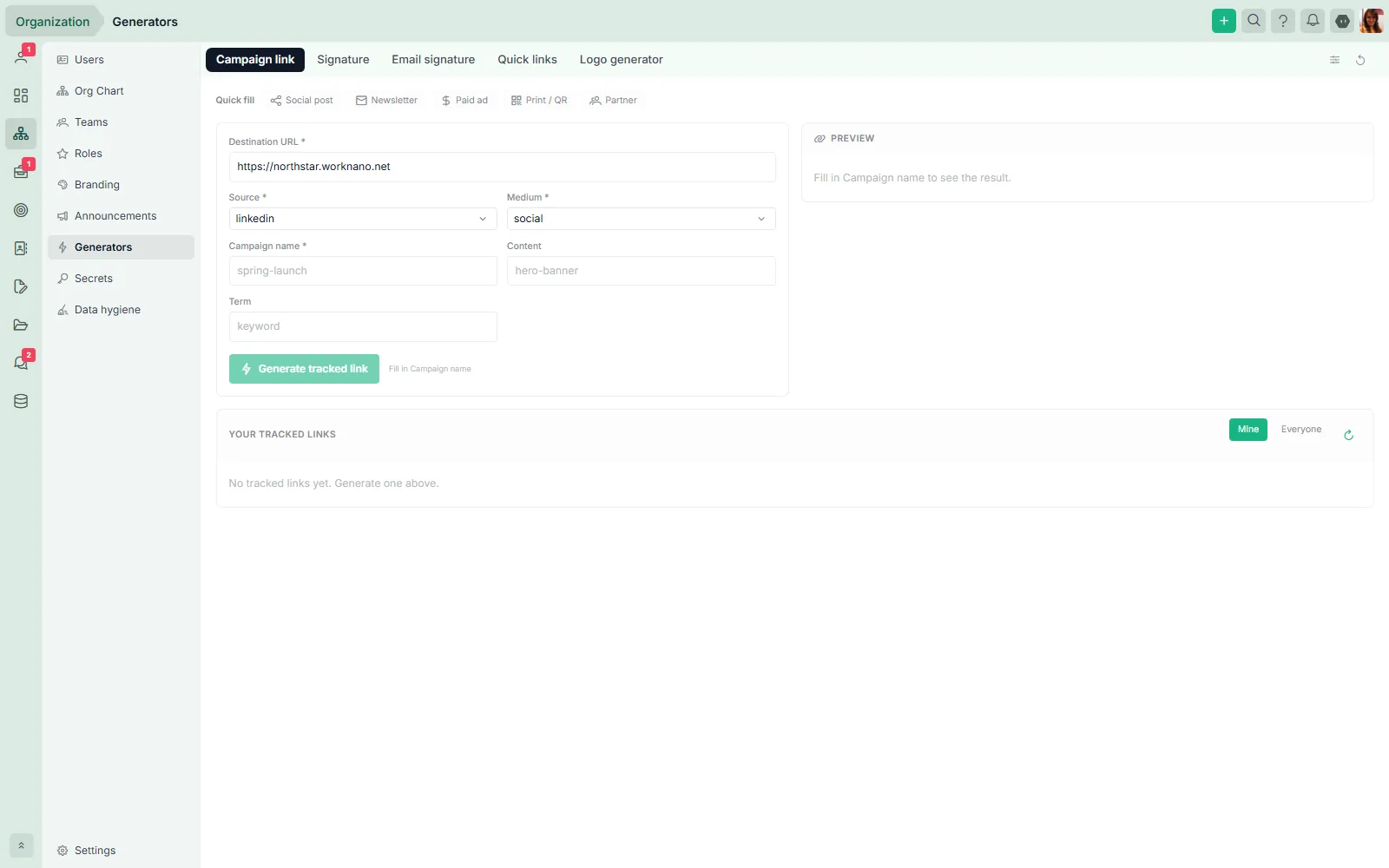
Mini Tools: Small helpers that make everyday work easier.
Some tasks are too small for a full app but too common to keep doing manually. Worknano brings handy mini tools directly where you need them, inside Branding, CRM deals, documents, or anywhere else in your workspace.
Multi-agent systems explained: when one agent is not enough
A multi-agent system shares a job between several AI agents, each with one narrow task. This guide explains when that helps, when one agent is enough, and how to keep a small team of agents under control.
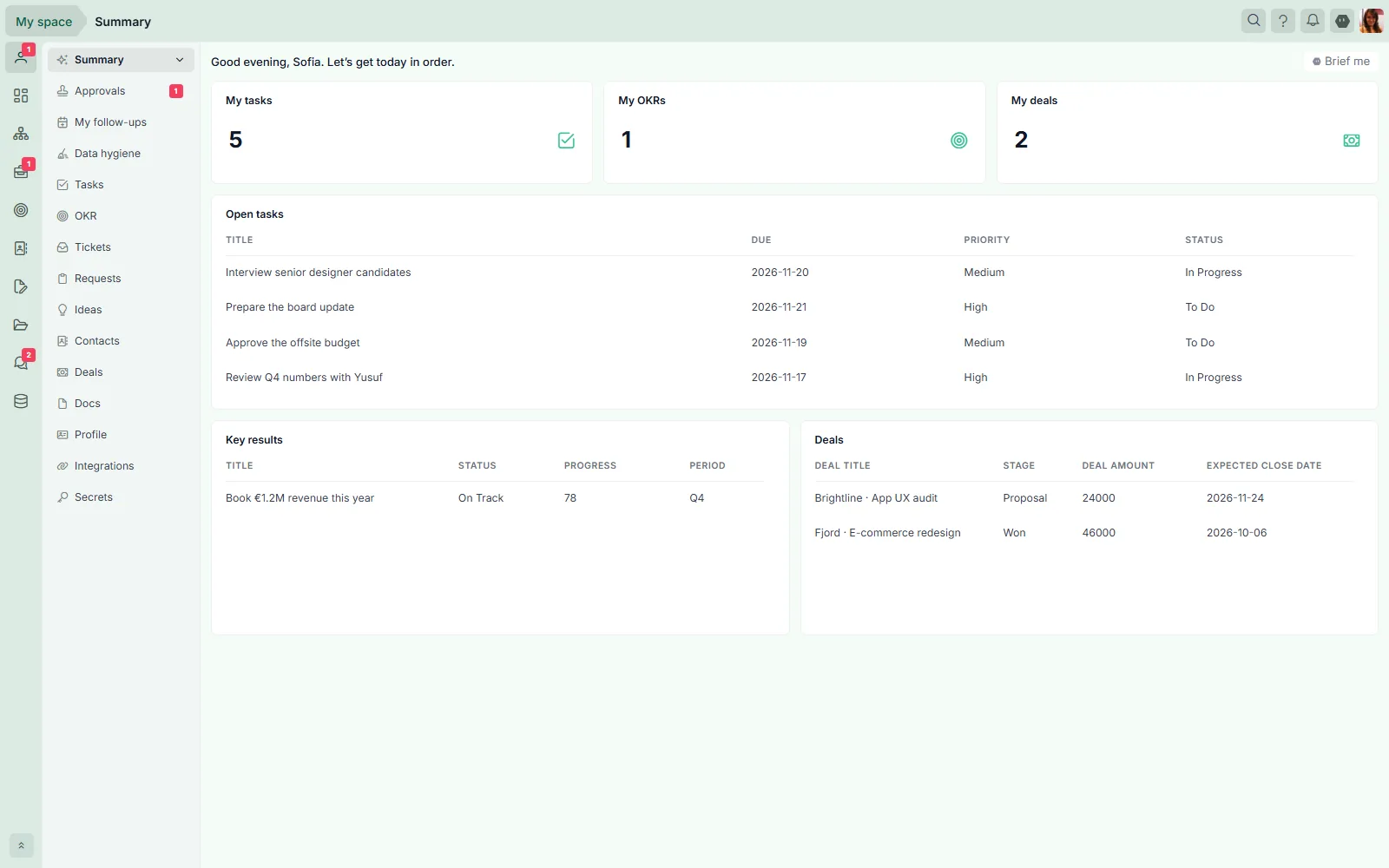
My workspace: today's priorities, surfaced from every module
Every modular SaaS has the same problem: the more modules a user has, the more places they have to check first thing in the morning. Worknano solves it with a personal home called 'My' that aggregates the work waiting for you across every module.
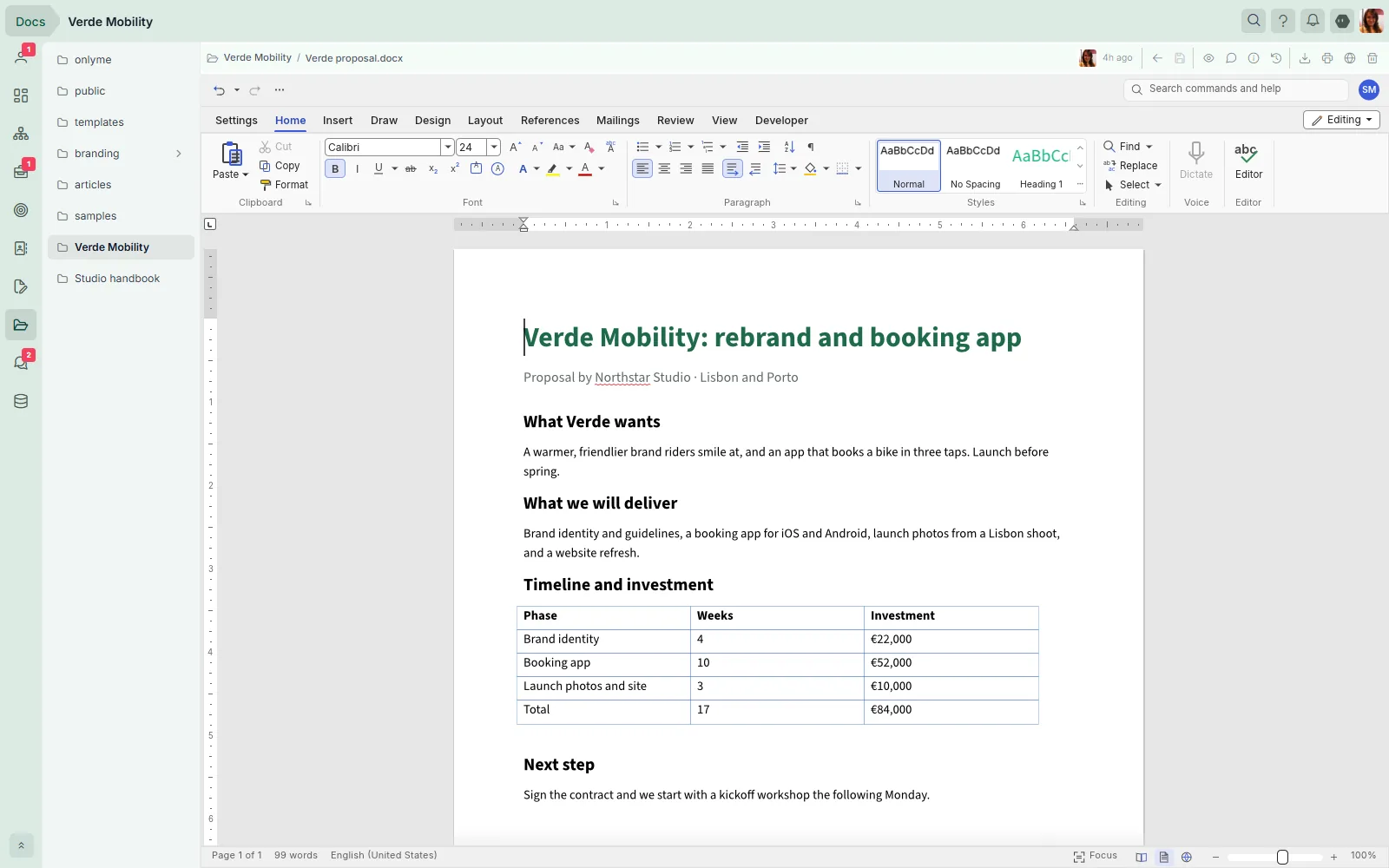
Design: the creative space for teams
The website builder handles your public site. Design handles images, decks, and boards in the same workspace.
Native integrations vs iPaaS vs custom code
There are three ways to make two programs share information. A native integration comes ready-made from your software maker, an iPaaS is a separate connecting service, and custom code is written just for you. Here is which one fits which job.
NGO: Donor Management That Builds Lasting Trust
"Our funding data was scattered across inboxes and spreadsheets, which created a high audit risk and endless administrative work.", Dr.
No-code vs low-code vs AI app builders
No-code tools let you build a small business app by clicking. Low-code tools add a little programming for the hard parts. AI app builders write an app from your description. What matters most is who looks after it afterwards.
Notification overload: rules for internal communication
Notification overload means so many alerts arrive that people stop reading them, and the one that mattered gets missed. Five simple rules fix it. The first is that an alert goes only to the person who has to do something.
Do you need OKR software, or is a spreadsheet enough?
For one team and one quarter, a spreadsheet is enough for your OKRs. OKR software is worth it once several teams share goals and nobody keeps the numbers up to date. Six simple signs show which stage you are in.
OKRs vs KPIs: what is the difference?
A KPI is a number you watch all the time to see if the business is running well. An OKR is a goal you want to reach by a set date. This guide explains both in plain words and shows how they work together.
OKRs without the religion: a calmer way to run quarterly goals
Most teams that adopt OKRs end up with a beautifully formatted spreadsheet, a quarterly off-site to write it, and a Friday afternoon four weeks later when nobody has touched it. The framework is not the problem; the religion is.
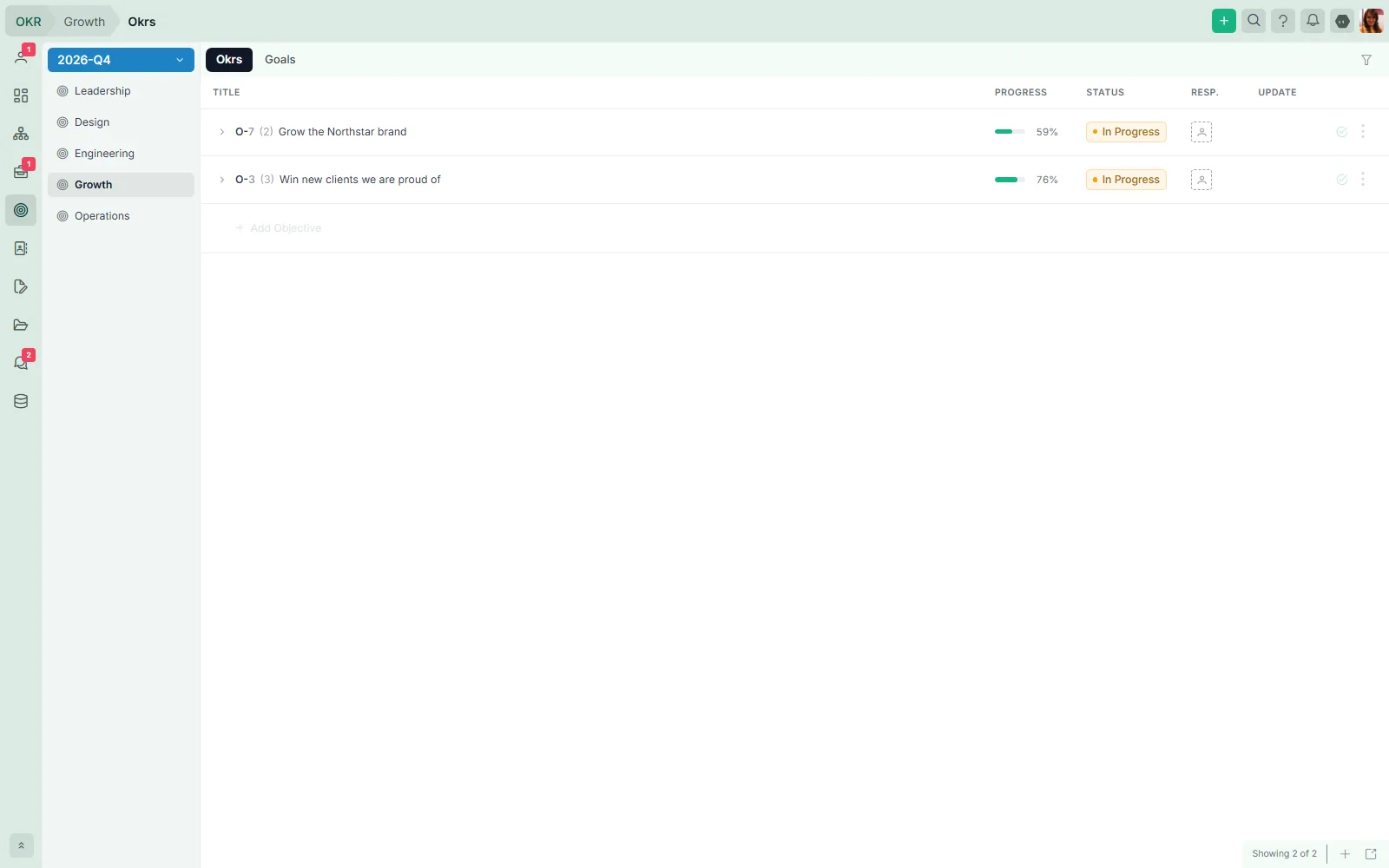
OKRs: Connected to real work, not hidden in spreadsheets
Most OKR tools fail because they are disconnected from the work. The team types the objective in January, types the progress in March, and never types again.
The one-person company: what AI agents can and cannot run
A one-person company can hand much of its routine work to AI agents. They sort requests, draft replies, keep records up to date and prepare reports. Selling, deciding and answering for the result stay with the owner.
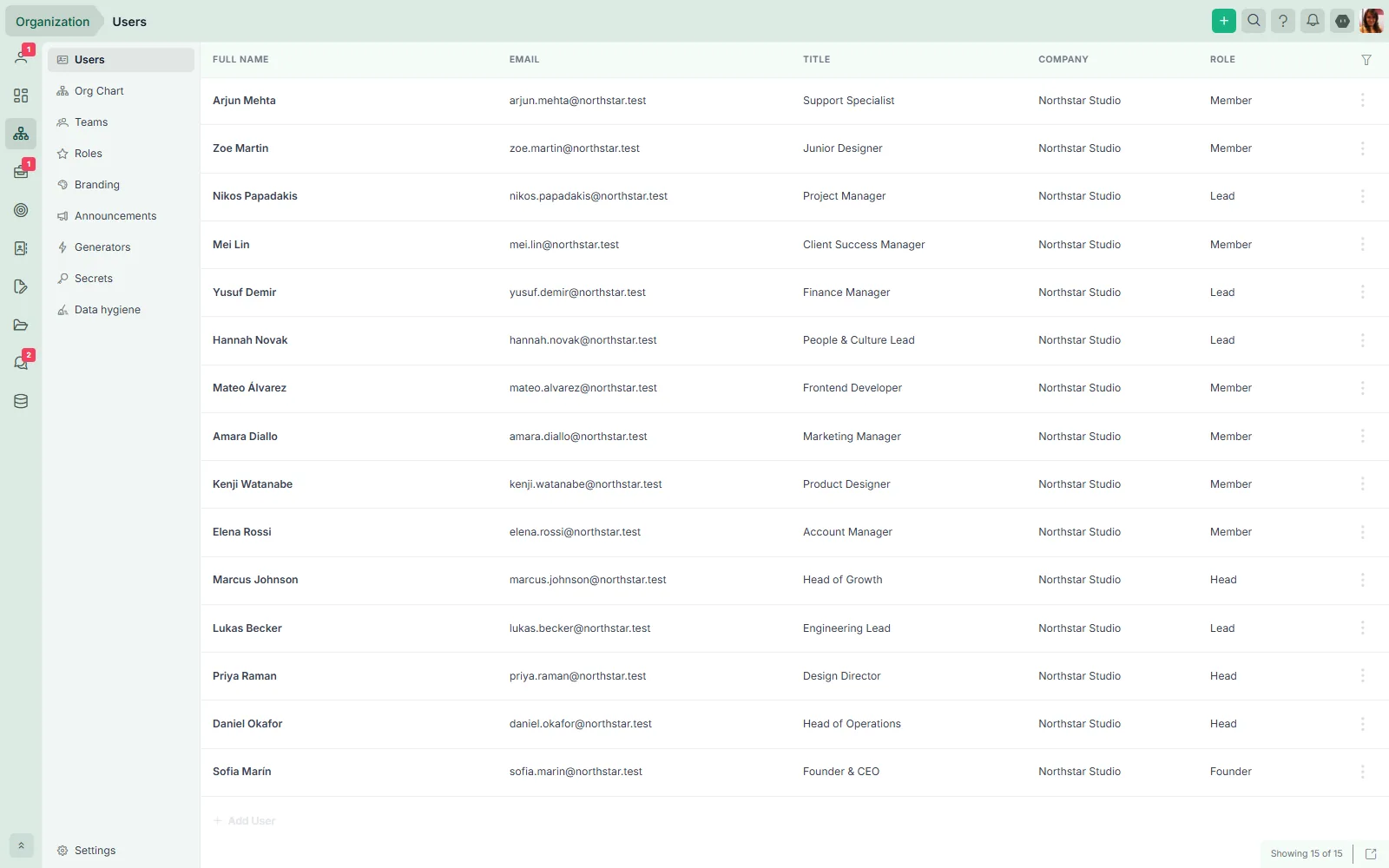
Organization: divisions, teams, users, all in one map
Most SaaS forces you to redefine your organisation in every product: who is on which team, who reports to whom, what each role can see. Worknano centralises the org structure so every other module derives permissions, approvals and reporting from one source.
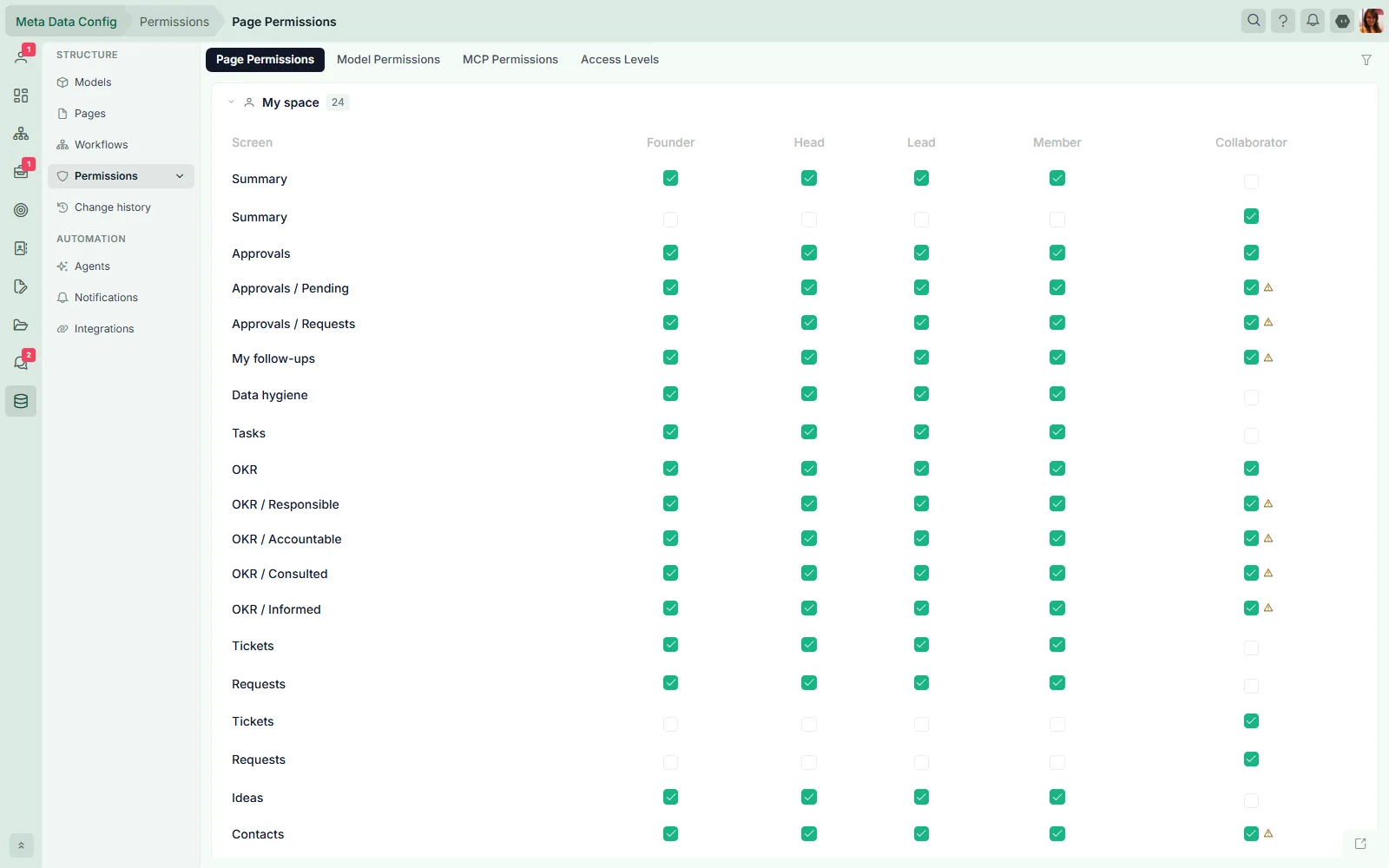
Permissions: roles, access, and who can see what
Most teams manage permissions separately in every tool, one matrix in the CRM, another in finance, a third in file sharing. Worknano centralizes access control in one place.
Process Mining: See how work actually flows in your workspace.
Every team has a written process and a real process. The written one lives in a slide deck.
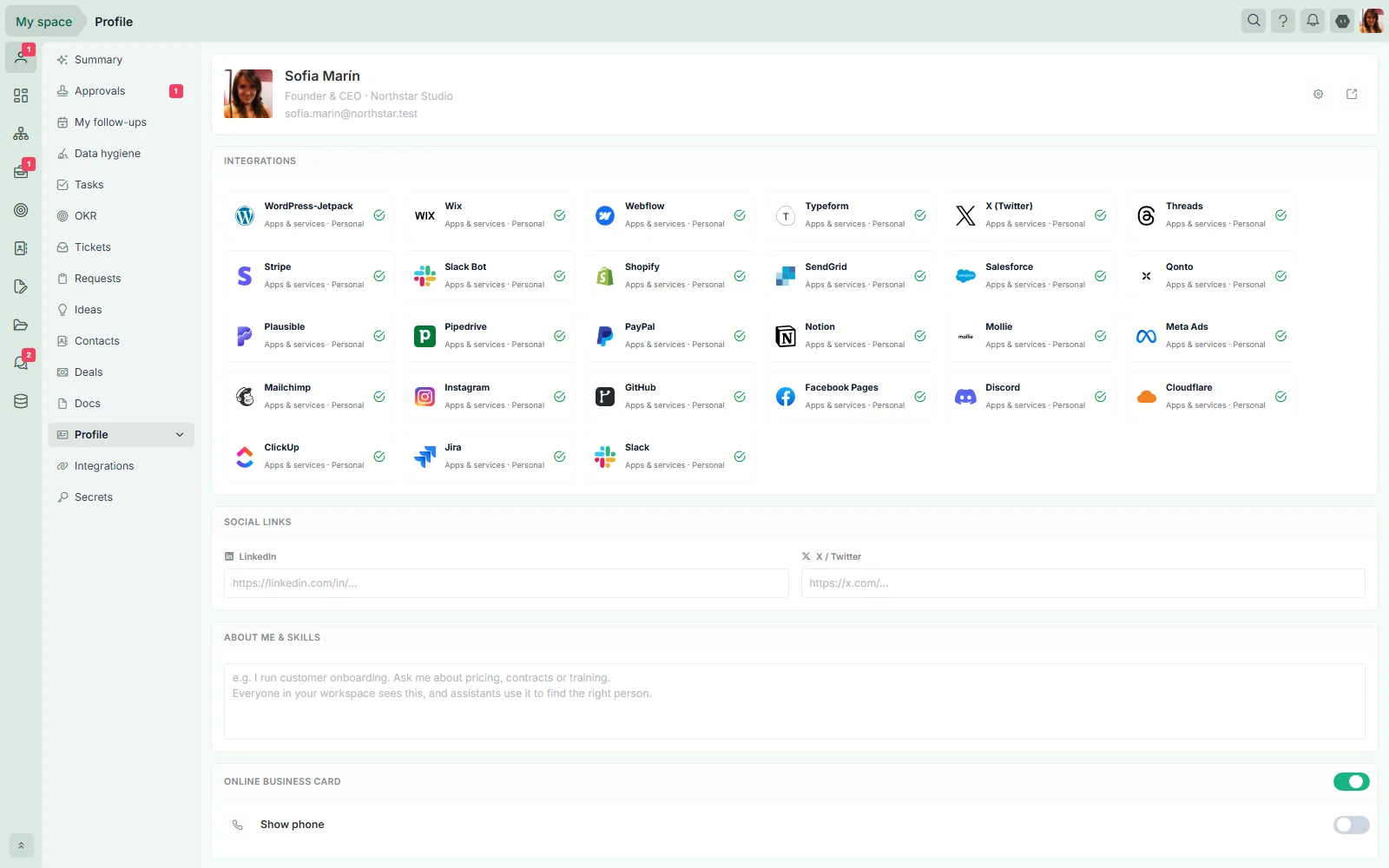
Profile: a public page, a digital business card, a booking link, all in one
A profile used to be a row in a directory. In Worknano, your profile is a public page you can hand out at a conference, install on a phone like a native app, and use as the booking link your customers schedule against.
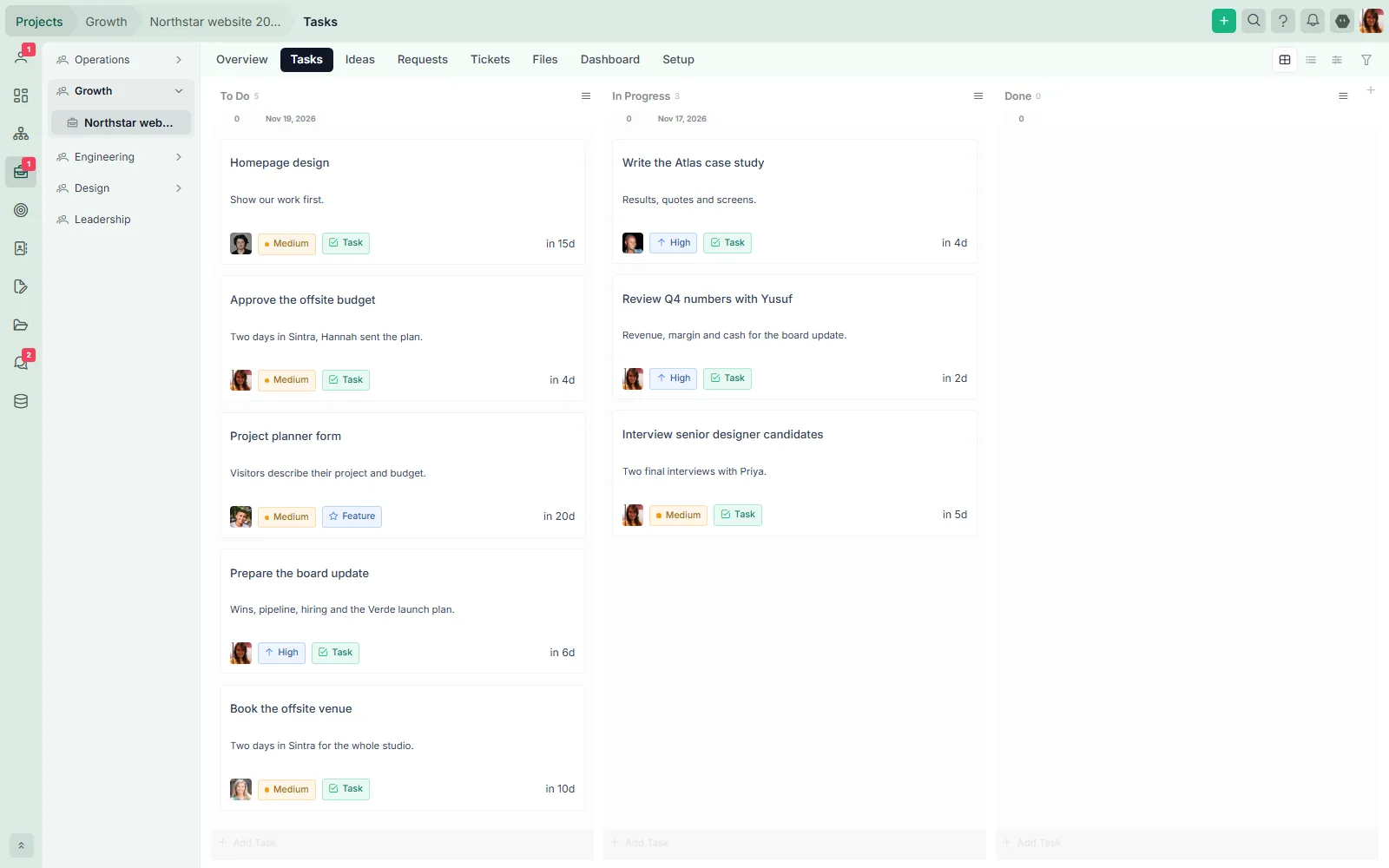
Projects that ship, not project tools that demo well
There is a category of project tool that looks beautiful in a screenshot and turns into a graveyard by week six. The reason is always the same: the team has to type the plan into the tool, then type the plan into a status doc, then type it again into the weekly review.
Prompt injection explained, with examples
Prompt injection is a trick. Someone hides an instruction in a text that an AI reads, and the AI follows it as if it came from you. Three examples show how it works and what keeps the damage small.
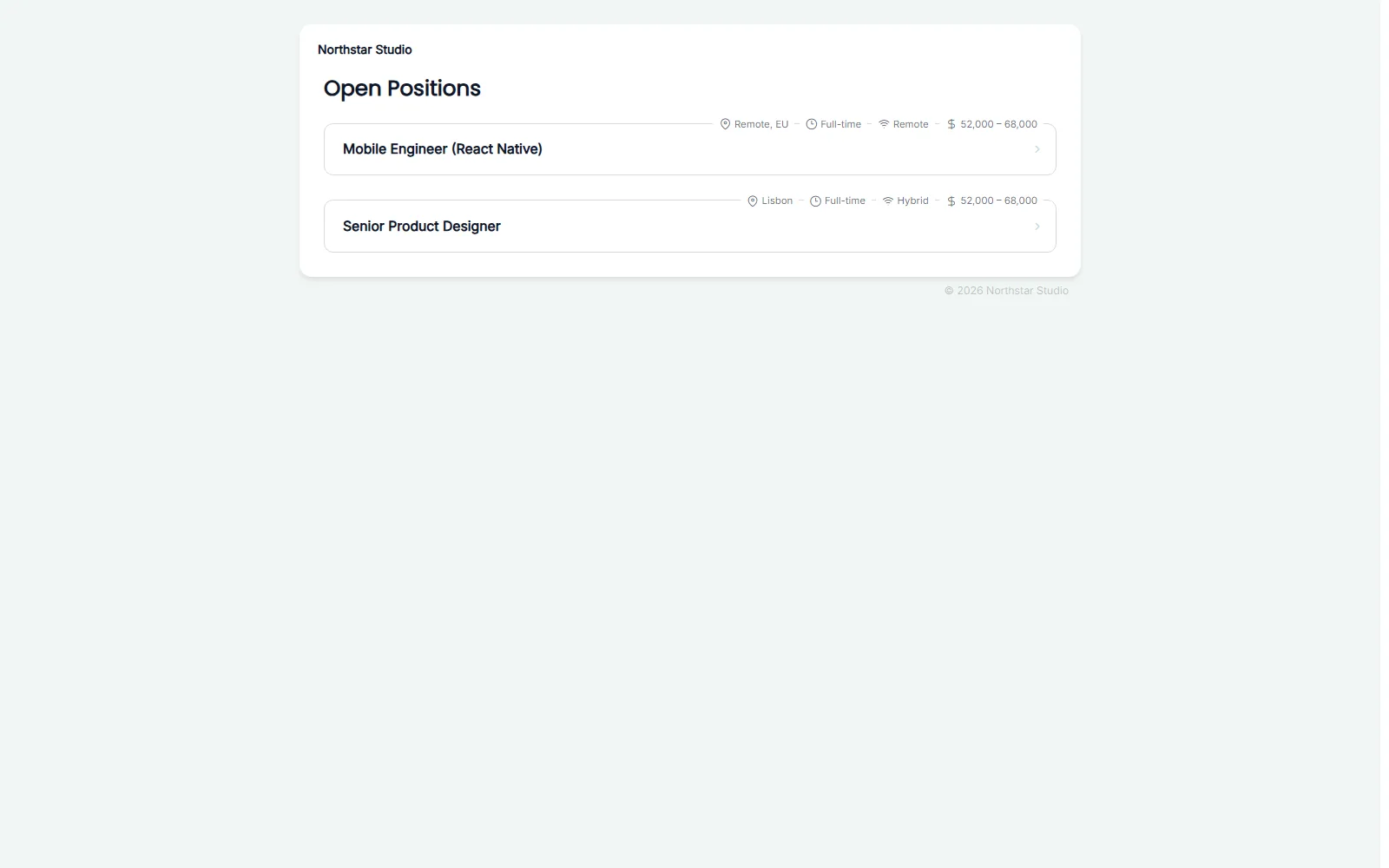
Public Pages let you safely share your data with the world.
Public Pages let you safely share your data with the world. Want to publish open job positions, upcoming events, blog articles, a knowledge base, team profiles or even selected CRM records?
RAG vs fine-tuning: two ways an AI learns your company
With RAG, an AI looks up your company's information at the moment you ask. With fine-tuning, the AI is trained further on your own examples so that its behaviour changes. One gives it knowledge, the other gives it habits.
RAG vs MCP: what is the difference?
RAG is a way for an AI to look things up in your documents before it answers. MCP is a standard plug that connects an AI app to your business software, so it can read exact records and carry out tasks. One finds text, the other reaches systems.
Ditch the bloated stack. Cancel the extras, keep one powerful workspace.
Open your company credit card statement and count the SaaS charges. Most small teams we work with are juggling tons of different tools.
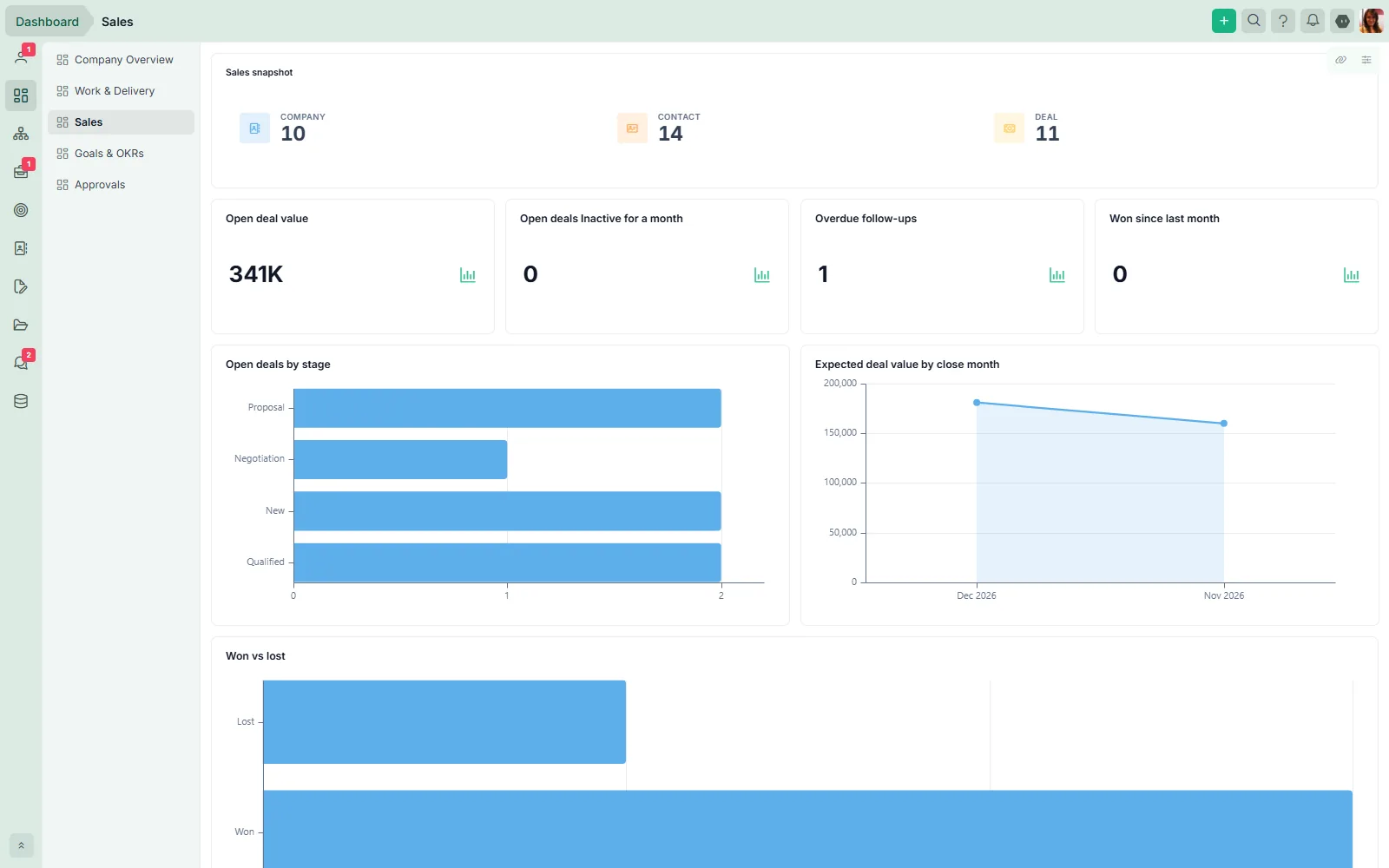
Reporting that answers the questions your teams actually ask
Worknano reporting is not a fixed set of charts, it is a workspace-native analytics layer you configure once and reuse everywhere. In the report designer, you choose the exact fields, filters, groupings and visualizations you want, then save that view as a dashboard, a report, or a shared insight.
Reports vs dashboards: which one answers which question?
A dashboard shows how things stand right now, and you glance at it often. A report explains what happened over a month or a year, and you read it once with care. This guide sorts common business questions into one or the other.
Roadmap: what's shipping next, in plain English
November 2026 Workflow designer, client sharing and a calmer app A new drag-and-drop workflow designer with decisions, loops, approvals, scheduled runs and AI steps. Clients see only their own records through a contact portal or a shared link.
Role-based access control explained without jargon
Role-based access control means you decide what a job such as "Sales" or "Finance" may see and do, and then give each person a job. This guide explains the idea in plain words, with an example for a twelve-person company.
SaaS sprawl: how to audit your tool stack
SaaS sprawl is what happens when software subscriptions are added one by one and never looked at together. A simple review takes about a day. Here are the five steps and the list to do it with.
Sales pipeline stages: how to define yours
Sales pipeline stages are the steps a sale goes through, from first contact to a signed order. Good stages describe what the customer has done, not what you have done. Here is a simple set to start with.
Scale without rewiring: add modules as you grow, never re-platform
Scaling a small business or startup is hard enough. The last thing you need is another painful migration when you outgrow a tool.
Secrets: a team password vault that stays in your workspace
Shared logins should not live in Slack threads or sticky notes. Worknano Secrets is a team password vault with access requests, role-based visibility, and an audit trail.
A security checklist before you ship an AI-built internal tool
Before your team starts using a tool that an AI built, run this security checklist. It asks who can get in, what each person can see, where passwords are kept and who looks after the tool. Ten checks, and you can do most of them by simply trying things out.
Self-hosting business software with AI: when is it worth it?
Self-hosting means running business software on your own computers instead of the supplier's. It is worth it when a rule or a contract demands it and you have people to look after it. For most small companies a hosted service is the better fit.
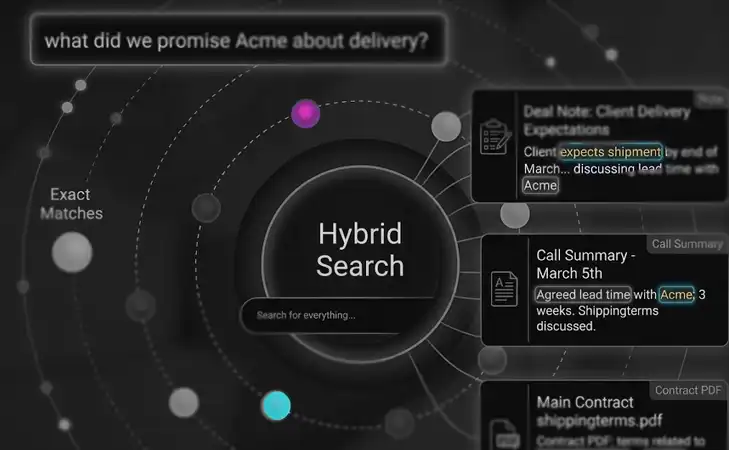
Semantic search: ask your workspace in your own words
Most search boxes match words. If you don't remember how something was phrased, you don't find it.
How a Series-A SaaS replaced 8 SaaS tools in one week
"The fragmentation was killing our momentum.
Shared inbox vs ticket system: when to switch
A shared inbox is one email address that several people read. A ticket system, also called a help desk, gives every customer request one responsible person and a clear state. Six signs show when it is time to switch.
Why AI agents need a single source of truth
A single source of truth means every fact about your business has one place where it is correct. People can work around two different copies. An AI agent cannot, so it needs that one place before you can rely on it.
Which KPIs should a small business track?
A KPI is a number that shows how your business is doing. A small business needs about five, covering money in the bank, new sales, expected sales, deliveries on time and returning customers. Each needs one responsible person and a fixed day to look at it.
Small business HQ: sales, ops, finance and people, under one roof
Small businesses rarely have a CIO to negotiate with vendors, a procurement team to consolidate licenses, or a technical team to wire everything together. The owner ends up doing it all themselves, usually between sales calls and while putting out daily fires.
Spreadsheet vs database: when is it time to move?
A spreadsheet is the right tool for sums and quick lists. A database is the right tool for customers, orders and other information that several people keep up to date for years. Six signs show when it is time to move.
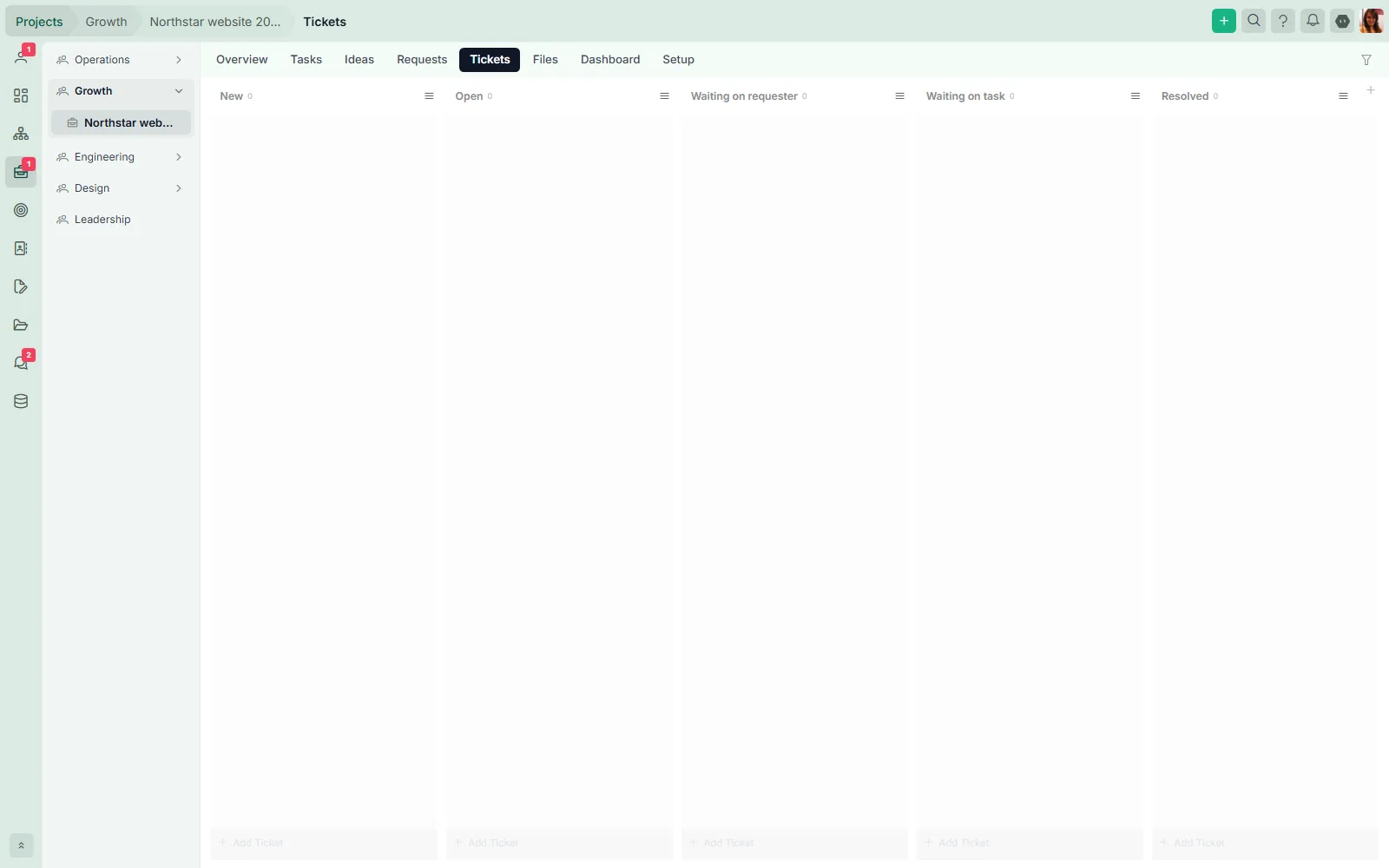
Tickets and client requests: every ask to a team in one place
Asks to a team usually arrive by email, in chat, in a shared spreadsheet and in a separate help-desk tool, and nobody sees the whole list. In Worknano they land in one menu entry, Requests.
System prompt vs user prompt
A system prompt is the standing instruction that gives an AI its job, like a job description. A user prompt is the request of the moment. This guide shows what belongs in each, with an example you can copy.
Task management vs project management
Task management means keeping track of single jobs. Project management means steering many jobs towards one result by a set date. This guide shows the difference with an example and helps you see which one you need.
Team chat vs email: what belongs where
Team chat is for quick questions inside the company that nobody needs next week. Email is for messages to people outside, and for anything that must still make sense months later. This guide sorts ten everyday messages into the right place.
Templates: clone a working playbook instead of starting from scratch
Starting from a blank workspace is fine if you have weeks to spare. Most teams do not.
Agent demo: delegate, review every change, then confirm
Ask the Task Assistant to move this week’s tasks. It shows each old and new date first, and nothing changes until you confirm.
Branding demo: one brand color, everywhere
Pick a brand color in Worknano and watch the app, a project board and a public form follow it.
Chat demo: mention people, link tasks, ask the assistant
In a project chat, @ mentions a teammate, # links the real task, and the assistant answers what is left this week, with links.
Module Creator demo: describe a tool, apply it, use it
Watch the Module Creator build a camera gear rental tool from one sentence, with linked models, a preview and a working page.
CRM demo: close a deal with its whole history
Drag a deal to Won in the Worknano pipeline and see the company, contact, owner and every call and meeting on the record.
Process mining demo: see where approvals get stuck
A process map of six weeks of client approvals shows the change-request loop, the records behind it and the one still waiting.
Dashboard demo: ask the assistant for a chart
Company and sales dashboards are ready from day one, and the Dashboard Assistant adds a new chart after you confirm.
Files demo: Word, Excel and PDF in the workspace
Open a Word proposal, an Excel budget and a PDF contract from Worknano and change them in place.
Forms demo: a public form that becomes a ticket
A client fills in a branded public form, and the answer lands on the support board as a ticket.
Integrations demo: bring a store’s numbers into a dashboard
See connected tools in Worknano and add a number from a connected store to the sales dashboard.
My page demo: your day, and the assistant that knows it
Open your own page in Worknano and ask the assistant what to focus on today, then for a chart of your open tasks.
OKR demo: key results that update with the work
See objectives and key results from the company down to a team, then a won deal completes a key result and its objective rolls up.
Permissions demo: who sees and changes what
From the org chart to page, record and AI tool permissions by role, then the same workspace as a junior designer.
Projects demo: from a won deal to the project board
A deal moves to Won in the CRM, keeps its company, contact and call history, and the team picks the work up on the project board.
Search demo: find answers by meaning, not keywords
Ask Worknano search a question in plain words and get the matching doc, plus the ticket, task and project around it.
Workflow demo: an AI check that runs every Monday
A scheduled workflow lets an AI decide which support tickets are urgent, asks a person when it is not sure, and keeps every run.
Website demo: build a page in the workspace
Edit a case study page in the website builder, add a section from ready widgets, and check it on a phone.
Worknano product videos
Short demos of Worknano: the Module Creator, search, agents, workflows, chat, OKRs, CRM, files, dashboards, forms, integrations, website, branding, permissions and process mining.
Worknano vs. Asana: Why Structured Databases Beat Disconnected Task Lists
If you are looking for a simple place to type out a basic task list, draw a generic kanban board, and assign a due date to a teammate, Asana is great.
Worknano vs. HubSpot: Stop Paying the "Contact Tax" for Features You Don't Use
If you are a heavily funded B2B enterprise with a massive marketing department dedicated to complex multi-path lead attribution, HubSpot is an exceptionally polished platform. It has spent years building a reputation as the friendly, low-code alternative to legacy corporate CRMs.
Worknano vs. Jira: Reclaim High-Speed Execution Without the Enterprise Bloat
For over a decade, Jira has been the default command center for traditional software engineering. If you are managing thousands of legacy code deployments and have a dedicated team of full-time Atlassian administrators to maintain your instances, Jira’s heavy, rigid framework serves its purpose.
Worknano vs. Monday.com: Stop Paying the "Integration Tax" for Lagging Boards
Monday.com is famous for its vibrant color palettes and visual flair. If your goal is to build a basic dashboard to manually track a handful of isolated team tasks, it is a highly capable tool.
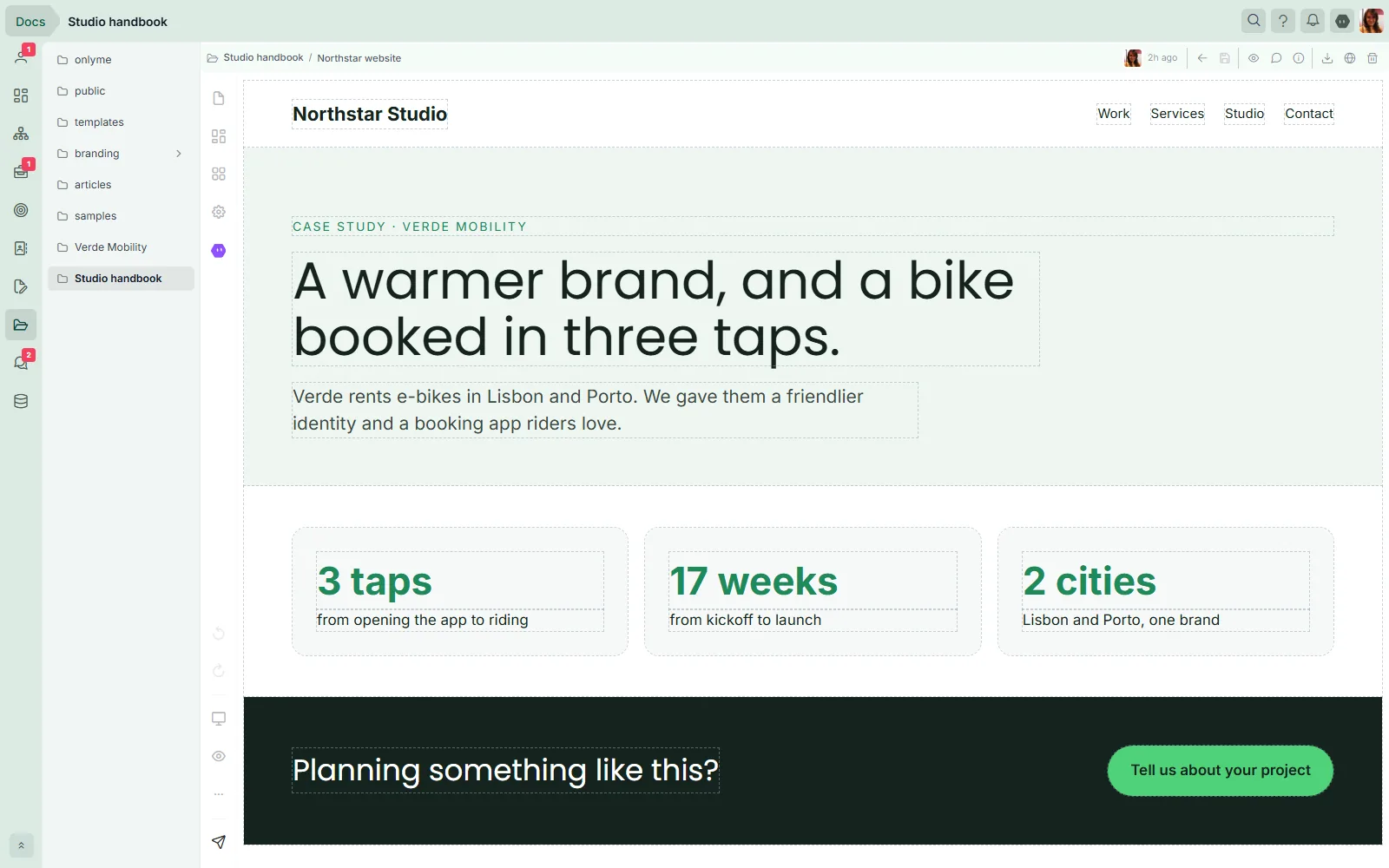
Website Builder: Ship a real marketing site from your workspace
If your marketing site, your help center, your blog, and your gated portal each live on a different platform, you pay four bills, manage four logins, and copy your brand kit into four places that drift.
What a small business website needs, page by page
A small business website needs five pages, and each one answers one question a visitor has: a home page, a page for what you offer, an about page, a page with proof, and a contact page. Add the legal pages your country asks for and the site is complete.
What are tokens in AI, in simple terms?
Tokens are the small pieces of text an AI reads and writes, usually a short word or part of a longer one. AI use is measured and billed in tokens, much like electricity is billed in units. Here is what drives the count and how to use fewer.
What does AI-native mean?
AI-native means a product or a company was planned from the start with AI doing part of the work. It is not an extra that was added later. Here is the meaning in plain words, and five simple questions to test any product that uses the label.
What is a brand kit, and what belongs in it?
A brand kit is a small set of files and rules that makes everything your company shows the world look like it comes from the same company. It holds your logos, colours, fonts and a few simple rules. Here is what to put in it.
What is a client portal, and who needs one?
A client portal is a private web page where a customer can see how their own job with you is going: what is done, what comes next, and which files and decisions belong to it. Each client sees only their own information, after a login or through a protected link.
What is a context window, and why does it matter?
A context window is the amount of text an AI can keep in view at one time. It works like a desk of a fixed size. That explains why long chats lose the thread, why large files are only partly read and why more text is not always better.
What is an agentic workflow? Meaning and examples
An agentic workflow is a business process in which an AI decides some of the steps itself, inside limits you set. This guide explains the meaning in plain words, with three levels and three everyday examples.
What is an AI agent? A plain explanation with examples
An AI agent is software that you give a job in normal language. It looks up what it needs and carries the job out step by step. Here is how that works, what agents are good at in a company, and where their limits are.
What is an AI employee?
An AI employee is a software helper presented as a member of the team, with a name, a role and regular duties. The picture is useful as long as you remember that it needs a manager and cannot take responsibility.
What is an MCP server?
An MCP server is a small program that lets an AI app such as Claude or ChatGPT work with one piece of your business software. This guide explains in plain words what it does, where it runs and how you connect to one.
What is MCP? The Model Context Protocol explained for business owners
MCP, the Model Context Protocol, is a shared standard that lets an AI app such as Claude or ChatGPT work directly with your business software. Here is what that means in daily work, and five questions to ask before you switch it on.
What is process mining, and does a small company need it?
Process mining uses the dates and times your software already records to show the route work really takes, and where it waits. A small company benefits once a job repeats often and its steps are recorded in one place.
What is workflow software? A brief introduction
Workflow software passes a piece of work from one step and one person to the next, so nobody has to chase it. This short introduction shows what it does, with an everyday example, and how to tell when your company needs it.

What is Worknano?
Your company, one platform. Search every record and file, adapt your tools with AI, and see where work gets stuck.
What to put in a press kit
A press kit is one page that gives a journalist everything needed to write about your company without asking you first. It holds a short description, key facts, logos, photos and a contact person. This checklist covers each item.
When does a company need an org chart?
A company needs an org chart when people can no longer say from memory who decides what. That usually happens between ten and twenty people. Here are the signs, what to write in each box, and how to draw the first one.
When does a small business need a CRM?
A small business needs a CRM when more than one person talks to customers, or when promised follow-ups get forgotten. Before that, a tidy spreadsheet does the job. Six yes-or-no questions show where you stand.
Where to store API keys and secrets in a small company
Keep API keys and shared passwords in one protected vault, where each person sees only what they need and you can look up who opened what. Chat messages, spreadsheets and emails are the places they should leave first.
Which AI model for which task?
Use the smallest AI model that does the task well. A fast model for short, frequent jobs, a balanced one for everyday work, a deep-thinking one for hard problems and a local one where data must stay in-house.
Which tasks should a small business automate first?
Automate first the tasks that happen often, always follow the same rule and do little harm if one goes wrong. This guide gives you three simple questions and a worked example to sort your own list.
Who is responsible for AI mistakes?
Who is responsible for AI mistakes? As a rule of thumb, the company that uses the AI answers for what it does. This general guide shows how a small company can share out that responsibility clearly. It is not legal advice.
Why AI agent projects fail before they go live
The AI agent failure rate people quote has little to do with the technology. Most agent projects stop because nobody is in charge, the job is vague or the trial never ends. Here are the reasons and a fix for each.
Why are AI agents so slow, and what speeds them up?
AI agents are slow because they work in rounds. They read, decide, look something up and start again, and every round takes a few seconds. Here is where the time goes and what shortens the wait.
Why do AI agents hallucinate, and how do you prevent it?
An AI agent hallucinates when it says something that sounds right but is made up. The main cause is missing or unclear information. Most of the fix is giving the agent the right information to work with.
Will AI agents replace SaaS?
No. An AI agent needs a system that keeps the data, decides who may see what and records what was done. Business software with its own data becomes the place where agents work. What changes is how people use it.
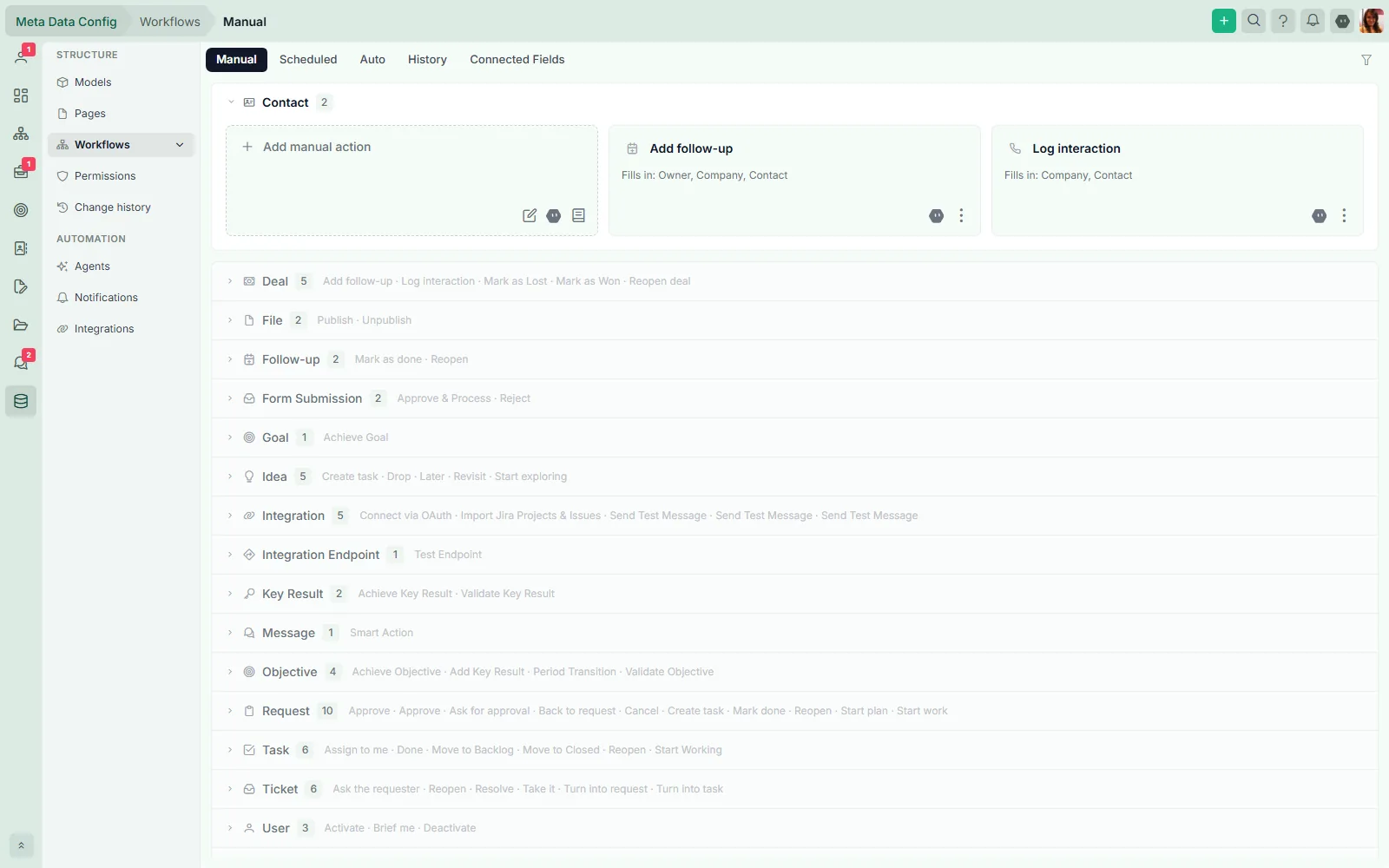
Workflows are how Worknano automates work between modules.
Workflows are how Worknano automates work between modules. Instead of building automation in a separate app and then trying to glue it back to your CRM, projects, or invoices, Worknano puts automation inside the same workspace, the same data model, and the same visual builder you already use.
Use Worknano as an app on desktop and mobile
Install your workspace on desktop or mobile, choose your notifications and keep your business card close. Native apps are in development.
Worknano vs. 1Password: Company Secrets in the Same Workspace as Your Work, Customizable with AI
Most companies do not have a password problem. They have a fragmentation problem.
Worknano vs. Airtable: Stop Managing "Bases" and Start Running Your Business
Airtable is often the "gateway drug" for teams moving away from spreadsheets. It’s colorful, intuitive, and great for prototyping.
Worknano vs. Bolt.new: Build Scalable Corporate Infrastructure, Not Single-Browser Spaghetti Code
Bolt.new (by StackBlitz) introduced a remarkable technical achievement: a full-stack development workspace that runs an entire Node.js development server, terminal, and live preview container directly inside a single browser tab.
Worknano vs. Calendly: Build a Smart Team Presence, Not a Matrix of Messy Links
Calendly is the undisputed pioneer of eliminating the agonizing "what time works for you?" back-and-forth email chain. If you are a solo consultant who just needs a static webpage to let people book a 30-minute chat, it is a perfectly capable tool.
Worknano vs. Canva: Reclaim Unified Team Layout Design Without the Premium Pricing Spikes
Canva completely democratized digital asset creation by replacing complex graphic suites with an intuitive, drag-and-drop template interface. If you are an individual creator spinning up high-level social media banners or editing a single presentation deck, it is a highly accessible web tool.
Worknano vs. Celonis: Enterprise Process Intelligence Without the Multi-Million Dollar Project
Celonis is the absolute titan of the enterprise process mining market.
Worknano vs. ClickUp: Focused Core Functionality, Shaped With AI on One Platform
Most companies do not need more features. They need the few things they do every day to work well together: plan projects, track goals, manage customers, talk as a team, collect information and see where things stand.
Worknano vs. Eventbrite: Events in the Same Place as Everything Else You Run
Most teams do not run events as a business on their own. They run webinars, customer days, trainings, volunteer shifts, partner meetups and community gatherings because those events feed everything else: the pipeline, the onboarding plan, the community, the quarterly goals.
Worknano vs. Framer: A Website That Lives Where Your Forms, CRM and Team Already Work
A website is rarely the end of the journey. A visitor reads a page, fills in a form, becomes a lead, turns into a deal and eventually a customer with projects, events and support questions.
Worknano vs. Lattice: OKRs That Live Next to Your Projects, Customers and People
Most companies set goals in one tool and do the work in five others. The objective lives in a goal platform, the project in a board tool, the pipeline in a CRM and the discussion in a chat app.
Worknano vs. Linear: Project Tracking on One Platform You Shape With AI
Project tracking works best where the rest of the company already lives. Engineering work depends on what sales promised a customer, on the quarterly OKRs leadership set, on support requests arriving from users, and on approvals from people who rarely open a backlog.
Worknano vs. Lovable: Two different approaches to business software with AI
Lovable helps you build an application with AI. Worknano gives you a ready-made business workspace and lets you create additional modules through configuration. Here is what that difference means for your team.
Worknano vs. Make: Automation That Runs Where Your Data Already Lives
Most teams reach for an automation platform because their tools do not talk to each other. Leads arrive in a form tool, deals live in a CRM, tasks sit in a project board, and an external scenario copies data from one to the next.
Worknano vs. Microsoft Teams: Team Chat That Lives Next to Your Records and AI Agents
Many companies end up with a large communication suite because it came bundled with something else. Chat, calls and channels arrive in one package, and the team starts talking there.
Worknano vs. Miro: Turn Your Whiteboards Into Real Database Engines
Miro pioneered the art of the infinite digital whiteboard. If your goal is to hold an ad-hoc sticky note brainstorming session, sketch out an unstructured mind map, or host a casual remote team workshop, it is a highly responsive visual workspace.
Worknano vs. n8n: Native Data Environments vs. Fragile Pipeline Construction
n8n has established itself as an elite, developer-centric powerhouse for building intricate, node-based workflow graphs. If you are an automation engineer who loves writing custom JavaScript transforms, connecting obscure rest endpoints, and managing server infrastructure, it is a brilliantly designed tool.
Worknano vs. Notion: Stop Building Your Own Software and Start Running Your Business
Notion is a beautiful canvas. It is the ultimate tool for individuals who want to build a "second brain" or a pretty wiki.
Worknano vs. Personio: Scale Fast Across Borders Without the Legacy Rigidity
Personio has carved out a massive reputation as the default all-in-one HR platform for European small and mid-sized businesses, particularly in Germany.
Worknano vs. Pipedrive: A Sales Pipeline That Lives Where the Rest of Your Company Works
Pipedrive is a sales CRM built around the pipeline: deals, stages and the activities that move them forward. For a sales team, that focus feels natural.
Worknano vs. Salesforce: Reclaim Simple, Fast Revenue Growth Without the Enterprise Bloat
Salesforce is the undisputed titan of legacy corporate software.
Worknano vs. Slack: Work Chat Where Your Records and AI Agents Already Live
Most teams adopt a chat tool to talk faster. Then the talking drifts away from the work.
Worknano vs. Trello: Kanban Boards Connected to Your Goals, Customers and Team
A kanban board is only as useful as the context around it. A card that says "Update onboarding flow" tells you very little on its own.
Worknano vs. Typeform: Stop Paying Premium Rent for a Fancy Front Door
Typeform revolutionized data collection with its sleek, one-question-at-a-time conversational interface. If you need a beautifully polished survey to capture high-level consumer feedback, it is a highly capable design tool.
Worknano vs. Webflow: Escape the Class-Naming Grind and Rigid CMS Ceilings
Webflow is an absolute powerhouse for pixel-perfect visual design, giving frontend creators unparalleled control over CSS properties and layout animations directly inside the browser canvas. For design agencies building highly stylized, static corporate portfolios, it is an exceptionally robust interface.
Worknano vs. WordPress: Break Free from Plugin Hell and Constant Security Audits
WordPress is the foundation of the traditional web, currently powering over 40% of the internet. If you are building a straightforward content blog and have an IT squad dedicated to managing manual server stacks, caching frameworks, and weekly security updates, it is a highly understood piece of legacy software.
Worknano vs. Zapier: Stop Paying the "Automation Tax" for Tools That Should Already Be Connected
The modern startup tech stack has a dirty secret: we are all paying a "tax" just to make our software talk to itself. Zapier has become the duct tape of the internet, and we have normalized paying monthly subscriptions to manage our other subscriptions.
Worknano vs. Zoho: One Platform, One Database, One Experience Instead of a Suite of Apps
Zoho sells a large catalog of business applications, and Zoho One bundles many of them under one subscription. That is a suite: a collection of separate products, each with its own interface, its own settings and its own way of storing data, connected to each other after the fact.